
Steve Peak: August Bank Holidays
The August Bank Holiday has been the setting for a number of historic events in Hastings, especially the opening of Hastings Pier in 1872 and the Mods and Rockers riots in 1964. But in both those years the bank holiday was not on the last Monday in August, as it is now, but on the first one.
Today there are bank holidays in England Wales on New Year’s Day, Good Friday, Easter Monday, the first and last Mondays in May, the last Monday in August (the 25th this year), Christmas Day and Boxing Day.
Bank holidays came into existence in 1871 when the banker-turned-politician Sir John Lubbock introduced the Bank Holidays Act. He wanted to create a legal reason why everybody should not have to work all the year round. Sundays, Good Fridays and Christmas Days were then the only non-work days, but banks had to stay open every other day because holders of bills of exchange had the power to require payment on those days.
The 1871 Act added East Monday, Whit Monday, the first Monday in August and Boxing Day to Good Friday and Christmas Day as public holidays. Then in1971 the Labour government passed the Banking and Financial Dealings Act “to alleviate the growing congestion at the peak of the holiday season”. New Year’s Day and the first Monday in May were made public holidays, and the August Bank Holiday was moved from the first Monday in the month to the last.

Because the 1871 Bank Holidays Act was passed late in the year, Hastings Pier was opened to the public on very first significant August Bank Holiday – August 5, 1872.
The launch of the pier was an important development in the history of Hastings and St Leonards as a coastal resort, turning the town into a major attraction for south-east Londoners wanting a good day out beside-the-sea. The beautiful ground-breaking pavilion on the end of the pier was in almost constant use for entertainment and music until it burnt down in 1917.
The 910-feet long pier was an immediate success, attracting 482,000 people in its first 12 months and 584,000 in the second, much bigger numbers than had been expected. Especially popular was the band playing every day. Entry to the pier cost 2d, bringing £4,000 income -a sixth of the capital cost - in just 12 months.
Hastings Pier was formally opened by Earl Granville, Lord Warden of the Cinque Ports, on a very wet and windy Monday. The South Eastern Railway Company provided a special train from London to Hastings, bringing the Earl and some shareholders, to be welcomed at Hastings Station by the mayor and the town’s two MPs. A procession then set off in carriages through the heavy rain and strong winds that were to spoil most of the day.
The pier soon became established as the best music, theatre and variety venue in the borough, offering a continuous round of entertainment for visitors and townsfolk alike. However, this was partly due to the lack of any serious competition in the town, and many rival businesses were set up over the next three decades.
The biggest competitors were to be the Gaiety Theatre (now the Odeon Cinema) which opened in 1882, the St Leonards Pier, completed in 1891, and the Empire Theatre (now the De Luxe Leisure Centre) in 1899.
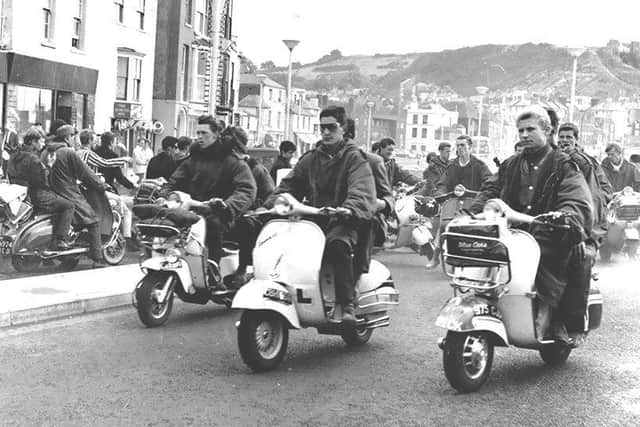
Hastings Pier also played a major part in another historic event – the Mods and Rockers riots on the bank holiday weekend of 1-3 August 1964. The Mods were smartly dressed ‘modern’ youngsters with short hair, often riding the latest fashionable scooters, while the Rockers were leather-jacketed long-hair motor-bike riders, like Marlon Brando in the 1953 film The Wild One.
These contrary youth cultures of the early 1960s got along reasonably well until Easter Monday 1964. On a wet and boring day in Clacton, when not much was happening, several hundred of these rival youngsters from London had some minor clashes. But the media over-inflated the story, calling it a ‘Day of Terror’, and this tabloid frenzy prompted thousands of Mods and Rockers to live up to their new roles in society by staging some real rioting in Margate, Clacton, Brighton and Bournemouth on the Whitsun bank holiday at the end of May in 1964.
So the weekend of August 1-3 was the last chance that year for the mods and rockers to have some bank holiday fun – and so about 5,000 of them came to Hastings. The excitement began on the Saturday night when the Rolling Stones appeared on Hastings Pier. They arrived in the back of an ambulance, greeted, said the Observer, by “crowds of shouting youths and screaming girls”. About 1,800 fans were crammed into the pier’s ballroom, despite its legal limit of 1,200.
The Mods and Rockers’ climax (and their last-ever major get-together) came on the Monday, 3 August, with large crowds on the beach between the pier and the harbour, and groups on scooters and motor-bikes roaring up and down the seafront. The Mods, many of whom had come by train, outnumbered by far the bikers.
There were occasional clashes, but the large number of police managed to keep them separated most of the time. The day fizzled out when the police forced large numbers of the insurgents to go in a procession up Old London Road through Ore to the town boundary on the Rye Road, from where the Mods and Rockers could find their own way back into town, often tired and exhausted by then.