
'Extremely high levels of E. coli' - Sewage misconnection discovered in Worthing after swimmers raise water quality concerns

A significant source of bacterial pollution, affecting part of the coastline in Worthing, has been identified and resolved, according to the local authority.
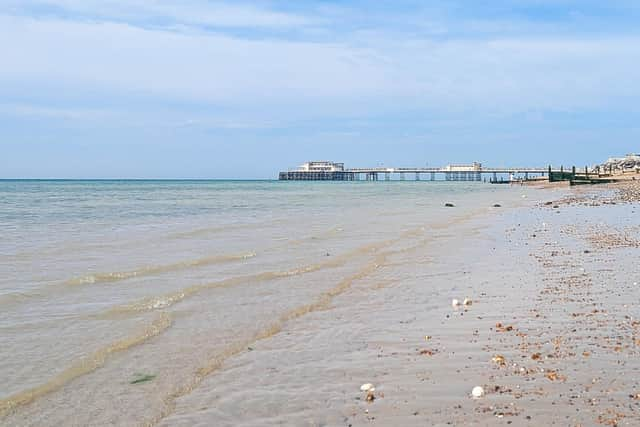
The issue relates to water quality monitoring at Worthing Beach House, the stretch of coastline opposite Splashpoint Leisure Centre, which became a designated bathing water site in May 2024.
Southern Water revealed that a ‘misconnection’ led to wastewater being discharged 'straight onto the beach', from a block of flats in Worthing.
A post explaining the situation was published by Worthing Borough Council on Facebook.

The council stated: “A significant source of bacterial pollution affecting our coastline has been resolved, thanks to our collaborative work with Southern Water and the Environment Agency.
“For the past two summers, the Environment Agency and Southern Water have been sampling the site’s seawater, testing it for harmful bacteria to understand the types and sources of pollution that may be impacting its water quality.
"Disappointingly, bacteria recorded in the data mean the seawater at Worthing Beach House is classified as ‘Poor’ – the lowest classification for the UK’s bathing waters – after its first two years of testing.”
The council said ongoing work is ‘helping to identify and resolve’ sources of pollution, which were ‘responsible for the elevated readings to help improve the water quality’.
The local authority added: “Recent water quality testing by Southern Water identified extremely high levels of E. coli in the Worthing Beach House area.
"Investigations traced the source to a block of flats where foul sewage from several properties had been incorrectly connected to a surface water drain, discharging into the bathing waters.
"Surface water drains are designed to carry only rainwater from roofs and road drains directly to the sea. The misconnection was immediately resolved by on-site plumbers, ensuring that foul water from the properties is no longer entering the sea.”
The council said misconnections from toilets, sinks, washing machines or dishwashers ‘can happen at any building’, and ‘can have a detrimental impact on the environment’.
"It’s therefore important to ensure your properties are connected to the right networks,” it added.
"Businesses and homeowners are encouraged to have their wastewater systems checked by Southern Water or a professional plumber if they're concerned about a potential misconnection.
"The successful identification highlights the value of the bathing water designation and ongoing work with partners to find and fix sources of bacterial pollution impacting the local environment.”
Tom Rutland – the MP for East Worthing and Shoreham – told his constituents, via social media, that ‘cleaning up our rivers and seas is an absolute priority for me’.
He added: “I was pleased to see that the bathing sites at Shoreham and Southwick’s beaches were rated as excellent, and Lancing Beach Green was rated as good last year – but I was extremely disappointed that Worthing Beach House was still classified as poor.
“Today (Friday, March 13), I met with Southern Water to discuss sewage discharges that had been directly affecting the coastline at Worthing Beach House, due to a significant misconnection from a block of flats.
“I welcome the news that the Environment Agency and Southern Water have worked collaboratively to successfully identify and quickly fix this significant illegal connection to prevent further sewage discharges into the sea at Worthing.
“Since being elected, I have met with Southern Water executives on multiple occasions to hold them to account and raised issues around sewage discharges in the House of Commons and directly with ministers.
“I am proud to have also secured a dedicated citizen science water quality monitoring facility for Worthing, funded by Southern Water and supported by South Downs Leisure, through working with Peter Kyle MP’s office, Cllr Vicki Wells and East Worthing's Muscle Beach Swimming Club.
“Nationally, our Water (Special Measures) Act has banned unfair bonuses for water bosses, introduced new fines for polluting water companies, and ringfenced bill increases for investment in our water infrastructure.
“After years of underinvestment, it will take time to clean up our rivers and seas, but the government has taken more action than any before it to ensure that we do.
“I share residents’ deep concerns about the state of our waterways. I seriously hope that the water quality at Worthing Beach House’s bathing site improves when it is tested later this year, and I will continue to advocate for residents by urging Southern Water to improve the rating.”
Sampling is carried out between mid-May and the end of September during the bathing water season.
An Environment Agency (EA) spokesperson said: “Urban drainage can have an impact on water quality at Worthing’s bathing waters. Anyone going for a swim or entering the water is urged to check our Swimfo website first to see if any pollution risk forecasts are in place.
“These forecasts are based on several factors, including recent heavy rainfall which can temporarily impact water quality.
“A lot of work is being done by the Environment Agency, Worthing Borough Council and Southern Water to drive up water quality standards at Worthing, Goring Beach and Worthing Beach House.”
The EA highlighted that testing looks for levels of E. Coli and intestinal enterococci.
This data is added to the previous four years of data to inform what classification a bathing water gets, to help inform decision making on swimming and other water activities.
Worthing and Goring Beach are both classified as ‘good’ and Worthing Beach House is classified as ‘poor’, meaning swimming is not advised.
This comes after a sea swimmer said she had been unable to enjoy the water this year, due to repeated wastewater releases.
Gill Collins said she was frustrated by the number of discharges from Southern Water’s East Worthing No.3 outfall.
Gill’s letter to the Herald read: “I am a sea swimmer, but I have not been able to swim this year because of the wastewater. Last year, for the same period, there were four releases. This year, from the first of January to now, there have been sixty-one genuine releases, all of which have affected the bathing waters of Worthing and Goring beaches.
"Can you explain why this is happening? Can it be stopped? Is it safe to swim in the sea during this time?”
Ms Collins referred to official figures, which revealed that in 2025 (between January 1 and March 10), Southern Water discharged untreated waste water, that ‘impacted Worthing Beach for just over three hours’.
She added: “This year, for the same period there has been 622 hours of genuine releases – 57 individual releases, impacting on Worthing beaches – this is a 155.5 fold increase – so really can’t just be attributed to rainfall.
"Surfers Against Sewage have advised against swimming while Southern Water continue their daily discharge and I have reached out to my local council.”
In response, a spokesperson for Worthing Borough Council told this newspaper: "We are committed to improving coastal water quality in Worthing for the benefit of residents, visitors and the natural environment.
"We are working closely with the Environment Agency and Southern Water to monitor water quality, tackle pollution sources and support long-term improvements.”
This followed a recent broadcast of Dirty Business on Channel 4, which examines sewage pollution in UK rivers and seas.
Southern Water pointed out that the number three outfall is 5km off-shore and – prior to construction of the wastewater treatment work in 1996 – this was the ‘only mitigation’, as wastewater received ‘rudimentary treatment’.
A Southern Water spokesperson added: “Torrential rain – more than double the average in both January and February has caused challenges across the region such as floods. In heavy rain, our system is inundated with run off from roads and roofs.
"To protect homes, schools and businesses from internal flooding the storm release system acts as a pressure valve. Through our Clean Rivers and Seas Watch service we put near time information on releases from every single storm release site in the region.
"With ever improving modelling the service provides more and more information about whether a release might impact water quality. We’re investing £1.5 billion over the next five years to slash storm releases.”
Real-time information on sewage discharges is available through the company’s Clean Rivers and Seas Watch website.