
Hassocks resident concerned about water supplies for thousands of new homes: South East Water ‘working to deliver solutions’

A Hassocks resident has expressed concerns about future water supplies if thousands of new homes go ahead.
Noel Thomas, of North Bank, contacted this newspaper following our coverage of a protest in Hurstpierpoint.
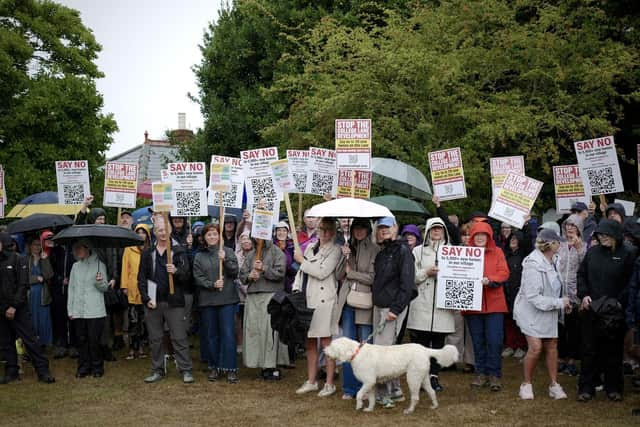

More than 200 people attended a demonstration on Hurstpierpoint’s village green on August 29, against speculative housing applications for almost 6,000 new homes in and around Hurstpierpoint, Sayers Common and Albourne.
Demonstrators expressed concerns about increased traffic, the possibility of public services not meeting demand, the Mid Sussex Health Centre operating at full capacity, emergency services not getting through congested areas, flooding and the impact on wildlife.
But afterwards, Noel contacted the Middy to voice another a major concern, asking: “Where is the water going to come from?”
He told this newspaper that the water in his area comes from a pumping station at Clayton. Noel said that during the recent heatwave the aquifer supplied water to the Hassocks area, including the large Tates Garden Centre. He also thought that water had been pumped to Burgess Hill overnight to replenish a storage facility there.
Noel said: “In addition, there is a major problem regarding leakage. I receive updates from South East Water regarding leaks in the Hassocks area.
“Since February, I have received in excess of 50 notifications. This must be resulting in the aquifer being depleted at an alarming rate, and given that it takes years for rain to permeate down into the aquifer, there can be little doubt that at some point this will have very serious consequences.”
He said he is particularly concerned that South East Water could be ‘losing thousands of litres of water every day’ across their network.
Noel said ‘one can only speculate’ on how water companies intend on supplying enough water in the future, adding: “The last nearby reservoir to be constructed was at Arlington, between Lewes and Polegate, and this was over 40 years ago.”
South East Water has since responded to say the company is ‘working to deliver solutions’ to maximise water supply where possible and is ‘working to reduce leaks and bursts’ as well.
Noel called the situation ‘perilous’ saying: “There is no way they will be able to supply services to some 6,000 new houses in this area.”
He said: “This is a situation that is going to get worse. We're going to get El Niño in a few weeks’ time and we all know about what that means and that’s going to exacerbate matters. We are not going to go back to having enough rain in the South East of England to resolve the problems that we face and that situation is going to get worse.”
He said that, more recently, there was a big leak near the traffic lights near North Bank and water was ‘gushing down the road for days’.
In response to Noel’s concerns, a South East Water spokesperson said: “We update our Water Resources Management Plan (WRMP) every five years and we have started the process of developing the next plan which will be published in 2029.
“Our current Water Resources Management Plan (WRMP24) was prepared in line with the statutory process and follows regulatory guidance. It is based on housing figures that were derived from available information published in 2023. Consequently, our WRMP24 does not reflect the significant uplift in the Objectively Assessed Housing Need (OAHN) that must now be delivered by Mid Sussex Council draft Local Plan. Without additional intervention, the borough’s projected housing growth will lead to demand exceeding available water supply.
“We’ve engaged constructively with the Department for Environment, Food & Rural Affairs (DEFRA) Water Delivery Taskforce to discuss water supply issues, and are working to deliver solutions to support growth in the area and maximise water supply where possible. We will continue to work in partnership with the council to support housebuilding and economic growth.”
South East Water said that, in accordance with the Water Industry Act 1991, it has a duty to connect new domestic properties to the water supply network as they are built. But it said, like other water companies, it is not a statutory consultee in the planning process.
The South East Water spokesperson said: “We are committed to working with all stakeholders to identify solutions if these are required. We’ll continue to work with planning authorities across our supply area to communicate the impact of the latest housing requirements. We will take account of up-to-date housing and employment forecasts in preparing our 2029 WRMP, the timetable for which is set by DEFRA.”
They said: “We share our customers’ frustrations at seeing drinking water lost to leaks and bursts and are working to reduce leaks and bursts across our network.
“We spend around £63 million a year on finding and fixing leaks across the network and are committed to investing further to reduce the amount of water lost to leaks by half by 2050.
“In the last year, we have found and fixed over 21,000 leaks on our network, and a further 6,000 customer-side leaks. This is around a 10 per cent increase on the previous year. We have more staff than ever finding and fixing leaks. In total, we have 400 people working on repairing leaks when they are reported, with a further 116 technicians searching for and finding leaks proactively.
“We’d like to thank everyone who takes the time to report leaks to us - it really does help us to find and fix problems on our network. If anyone spots a leak, it can be reported to us through our online AquAlerter platform: southeastwater.co.uk.”
Family-run Tates of Sussex would like to clarify the suggestion that South Downs Nurseries in Hassocks places significant demand on the local mains water supply.
"Water is obviously essential to a horticultural business, which is precisely why we have invested heavily over many years in our own water infrastructure rather than relying on the public mains network", says Tates' executive director Benjamin Tate.
"The vast majority of the water used across our sites is obtained independently through boreholes and recovered water. We do everything reasonably possible to avoid using mains water, which is very much a last resort. Quite simply, for a horticultural business of our scale, relying on metered mains water for irrigation would be economically unsustainable.
"We have also invested substantially in rainwater harvesting, recycling and storage infrastructure, including approximately three million litres of on-site water storage. This allows us to capture water when it is available, store it and reuse it for irrigation, significantly reducing the amount of additional water we need.
"This approach forms part of a much wider commitment across Tates of Sussex to more sustainable horticulture. We continue to invest in water conservation and responsible growing practices across our nurseries because reducing our reliance on mains water makes both environmental and commercial sense.
"We therefore feel it is important that any discussion about local water demand distinguishes between the volume of water required to operate a plant nursery and the amount actually being drawn from the public mains supply. They are two very different things", concluded Mr Tate.