
Hastings, St Leonards, Bexhill and Eastbourne among top Japanese knotweed Sussex hotspots
Hastings has been revealed as the joint top Japanese knotweed hotspot in East and West Sussex.
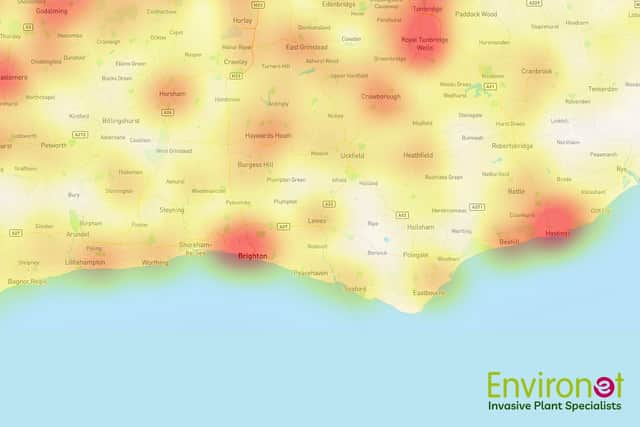
Data from Environet shows the knotweed hotspots for 2026 based on verified sightings from its live online tracker, Exposed: The Japanese Knotweed Heatmap.
It highlights where people are most likely to encounter the invasive plant.
A spokesperson said: "There are 938 verified sightings of knotweed across both counties, equivalent to 0.63 incidents in every square mile.

"If left unmanaged, knotweed can cause damage to buildings, hinder property sales and lead to legal disputes if it spreads across property boundaries. Research conducted by Environet in partnership with Censuswide in 2026 indicates that 7% of the UK’s homes – more than 1.58 million properties – are impacted by the invasive plant. Property values are typically reduced by around 5%, equivalent to £13,500 per home, highlighting the significant impact on the nation’s housing wealth.
"The rankings are based on invasive plant specialist Environet’s own enquiries, public sources and verified sightings submitted by members of the public using the map’s ‘Add Sighting’ feature. Homeowners and homebuyers can enter their postcode to discover the number of known sightings within a five-mile radius, with hotspots highlighted in yellow, orange, or in the worst cases, red."
Knotweed was Introduced to Britain as an ornamental garden plant in the Victorian period and has spread across the country through the movement of contaminated soil, waterways and more than 150 years of industrial activity, construction and infrastructure works, says Environet. Knotweed does not reproduce by seed in the UK since all the plants are female, but its root system can extend up to 7 metres laterally beneath the ground and once established, even tiny fragments can regenerate into new plants.
Environet Director Emily Grant said; "At this time of year, an established knotweed plant can be identified quite easily by its hard bamboo-like canes and distinctive bright green shield-shaped leaves which grow in a zig-zag pattern along the stem.
“The earlier it’s spotted, the easier and cheaper it is to deal with." How to spot Japanese knotweed:
Tall, upright canes which can reach 2 to 3 metres high
Dense clusters of stems emerge from a central crown in the ground
Large green shield-shaped leaves with a pointed tip grow alternately up the stem
By late summer, cone-shaped tassels of small creamy-white flowers emerge on the upper canopy
Sussex’s Top 10 Japanese knotweed hotspots showing rank, location and verified sightings: =1 Hove, East Sussex, 43 =1 Hastings, East Sussex, 43 =3 Brighton, East Sussex, 38 =3 Haywards Heath, West Sussex 5 St Leonard’s on Sea, East Sussex, 36 6 Horsham, West Sussex, 34 Crowborough, East Sussex, 31 8 Bexhill-on-Sea, East Sussex, 26 9 East Grinstead, West Sussex, 23 10 Eastbourne, East Sussex, 21