
Heavy rainfall in East Sussex: Lewes District Councillors endorse projects that reduce flooding risks from climate change

Cabinet councillors from Lewes District Council visited two locations recently where natural flood management initiatives are helping to store water.
The council said climate change is bringing increased rainfall to the UK, which means ‘more frequent periods of intense and heavy rain’ that could cause flooding and property damage.
The council said it its working with partners like the Ouse and Adur Rivers Trust, the Sussex Wildlife Trust and landowners, to deliver solutions that ‘create space for water’ and slow its flow.
Councillors Emily O’Brien and Mark Slater saw how Year 7 students at Chailey School have worked with the Sussex Wildlife Trust to build woody dams in the Romany Ridge area of Chailey Common, as part of the Wilder Ouse project.
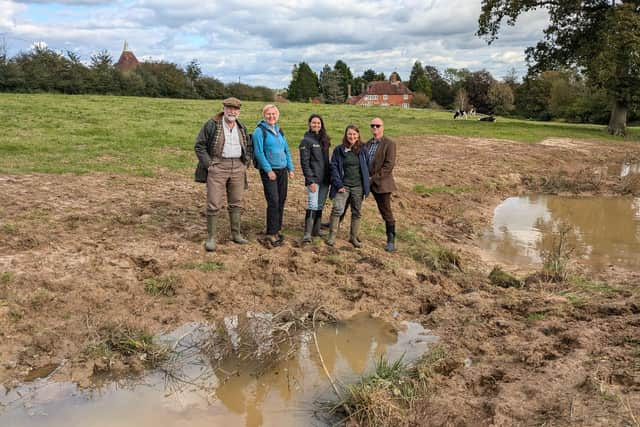

Councillor O’Brien said: “In addition to the students gaining a greater appreciation of the environment, their hard work has created a superb wet woodland habitat that can store up to 12,000 litres of water. This is win, win, win, for water storage, nature and the young people who have volunteered their time.”
Building these dams involves positioning branches and twigs across existing channels to slow the flow of water so it can be drained after the rain has passed.
The council explained that the team at Double Barn Farm on Newick Park Road are making their farm more resilient to climate change. They capture rainwater coming off barn roofs and hardstanding areas by using rain gardens and swales. These techniques store water and reduce residue pollution and levels of sediment. The stored rainwater can then be used on the farm.