
Brighton Philharmonic Orchestra, Brighton Dome. Sunday 28 September 2025, Review by Janet Lawrence
The new series of Brighton Philharmonic Orchestra concerts began in the afternoon of Sunday 28 September in the Brighton Dome. Artistic Director Joanna MacGregor, conducted the three contrasting works, with lead violin Ruth Rogers.
There’s a tuning up as musicians take their seats: trumpets testing tone; strings synchronising keys.
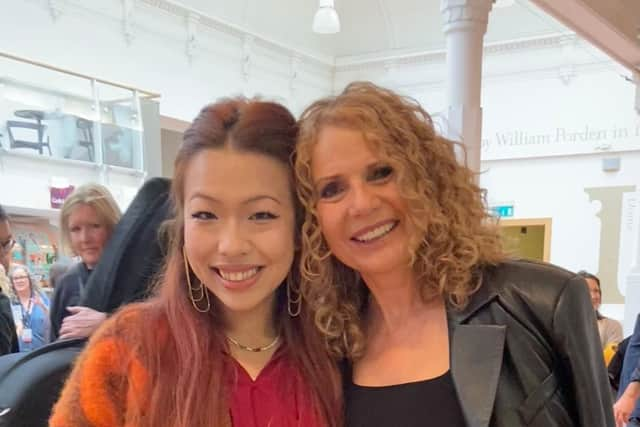
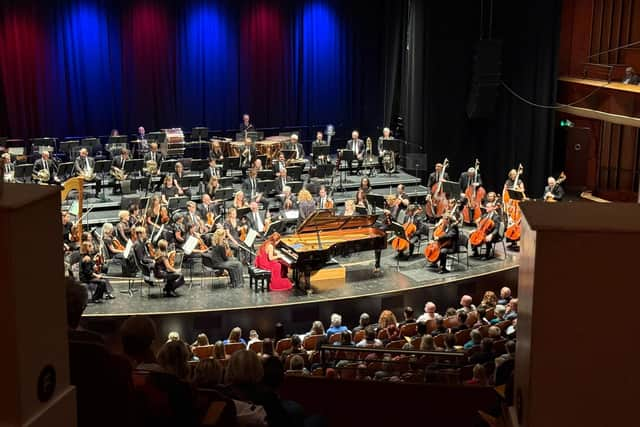
Rachmaninov’s Piano Concerto No 3 is the most famous of many difficult concertos. But accomplished pianist Junyan Chen, a former pupil of Joanna’s, gave life to this complicated piano piece, fingers tumbling around the keys with apparent ease. Looking lovely with red hair left loose, wearing a long red dress and a beguiling smile.
She gently lured us in for the start, trumpets echoing the melody, preparing us for the drama to come, guided by Joanna MacGregor’s passionate conducting. If ever a piano concerto could speak, it’s this one.

Scant percussion, except for the powerful resonance of timpanist Graham Reader’s occasional tap on one of his large kettle drums.
The second movement began with clarinet and strings in a peaceful sequence without the piano. In comes Chen with her left hand joined by the right, changing the mood.
It’s a delightful concerto with solos and intermittent orchestral accompaniments; light chords leading to wind and strings; a loud finale with the full orchestra.
The audience went mad with claps, whoops and shouts. Junyen played a short enclore, and left the stage carrying a big bunch of flowers.
We had the interval to absorb it all, and prepare for the two works that followed. The seemingly innocent Ravel’s La Valse, has a darker story. Being ‘mad about waltzes’, Maurice Ravel’s initial ‘homage to Johann Strauss’ became, by 1920, a nightmarish portrayal of the dissolution of society. Impresario Marcelle Meyer declared: “this is not a ballet, it’s a masterpiece” and it was triumphantly premiered at the Théâtre du Châtelet in Paris in December 1920.
Its beginning with wind and strings, work into the familiar theme; the harp comes into its own with glissandos, leading to the steady waltz theme with full orchestra and separate instrumental moments. A lively waltz with contrasts. Clashes of cymbals at the back, along with the incidental taps from the left hand corner; quick salutations from the brass, and a swift ending.
Bela Bartok’s rather disturbing orchestral suite from The Miraculous Mandarin completes the programme. Joanna recounts the stages of the story: three criminals force a beautiful girl to lure and rob wealthy men. Their third victim, however, a wealthy Chinese man (the Mandarin), survives violent attempts on his life, collapsing only when the prostitute gives herself to him in a final act of passion.
Composed between 1918 and 1924, the ballet premiered in Cologne in 1926 but was banned due to its violent and erotic themes. Bartók, however. considered it his greatest achievement.
A clarinet solo heralds the arrival of the first time the girl arrives. An oboe motif follows, while the girl does a little waltz. Clashing cymbals at the back precede a quick salutation on brass. There’s low clarinet interaction, followed by two soloists with grumbling double bass and timpani. To the left, a grand piano and a celeste tap the occasional note.
Alex Rider, on solo harp for this, joined with chords and plucks.
Such is the vividness of this performance that you can almost see each new “customer” being rudely dispatched – and when the Mandarin appears, the brass present him as an awesomely threatening figure. Best of all is the chase sequence that builds steadily to a towering crescendo.
This was a complicated piece, originally making me wonder what on earth sparked Bartok to compose it. I was daunted, on first listening to it at home, but with Joanna’s direction the whole fell into place and gave us a well-received and satisfying experience.
Next Brighton Philharmonic Orchestra concert: Sunday 19 October 2.45 pm, Brighton Dome. Tickets: 01273 709709; in person Brighton Dome Ticket Office, Church Street, Brighton BN 1 1UE; online brightondome.org.
Tickets from £13:00, with saver concessions for family members under 18 and with low income ; disabled facilities available. £10 tickets now for Under 30s.