
Review: Brighton Philharmonic Orchestra, Brighton Dome,

Sunday, October 19, Samuel Taylor-Coleridge and Gustav Mahler.
Review by Janet Lawrence
There were two significant works for this concert, part of the Brighton Philharmonic season compiled by its Artistic Director, Joanne MacGregor, and the second of its concerts.
Two contemporary composers from different backgrounds: Samuel Coleridge-Taylor (1875-1912) and Gustave Mahler (1860-1911); conducted by Alice Farnham, known to have led many major ensembles. Also keen to train more women conductors as well young singers and instrumentalists.
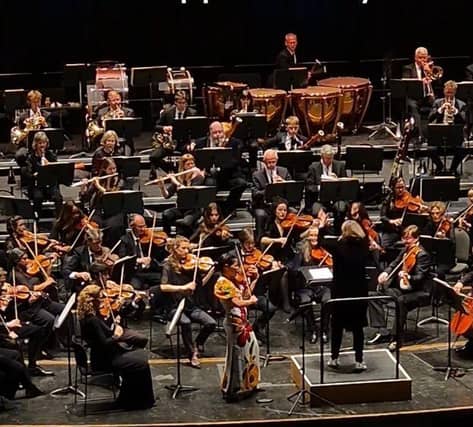
For the first half - the Violin Concerto in G minor by Samuel Coleridge-Taylor. He was born in England from a Sierra Leonian doctor and an English mother, and it’s heartbreaking to discover he died at age 37, having composed his Violin Concerto in G minor, and other works. Played in this concert by Elena Urioste.
Elena is attractive, bubbly and confident, with many orchestras and musical collaborations throughout her career, to her name. A treat for the eyes, she enters the stage wearing a long colourful dress and, before playing a note we love her already.
So being an accomplished player of Coleridge-Taylor’s Violin Concerto in G minor, she gave us a stunning performance.
The orchestra opens with a few bars that bring in Elena with a delicate tune followed by bass strings and woodwind. Many eloquent solo interludes are punctuated with orchestral support, guided by the steady strokes of conductor Alice Farnham.
The second, slower movement, opens with introduction from the violin section, then Elena delicately joins to continue the tune. In perfect sync with the orchestra with flutes sometimes meeting her violin.
Percussion thumps introduce the third movement, along with double bass, and joined by all violins. Elena pauses to let the orchestra take away the melody, then lures her back in with her exquisite playing. All looking so easy. Finally she lets the orchestra run away with the melody, illuminated by some three trombones and Graham Reader’s timpani. Then back to carry on the story with a few explanatory phrases from wind and strings.
Coleridge-Taylor’s work is full of melodious tunes, rising to a crescendo of brass, strings and wind, to bring us to its climax.
Following enthusiastic claps, Elena gave us a surprise encore with ‘Over the Rainbow,’ departing with a well deserved bunch of flowers.
After the interval: Mahler’s Fifth Symphony.
Gustav Mahler outlived Coleridge-Taylor by 14 years, but even at age 51, it was too young. Brought up in the Czech Republic (then Bohemia), Mahler was one of 15 children, eight of whom died at young ages.
Known, in his lifetime, as more of a conductor, he nevertheless composed five symphonies. I’ve known and loved Mahler’s first two where, as you might have gathered, I go on a lot about tunefulness. With this symphony, there are subtleties that tease the ear and give us a fulsome collection of themes that keep us on our toes.
There’s a nice peaceful opening to draw us in, with incidental activity at the rear on occasional percussion and other effects. Then some loud brass with trombones and a trumpet solo. There’s a large harp, left of stage, where Alex Rider, brings in the occasional audible plucks in the second movement. Glissandos and trills. And conductor Alice Farnham is somewhat more physical for this one.
The third movement opens with loud brass motifs. A capricious, playful movement with wind - clarinet, oboe, flute, taking turns with the cellos and double bass. And a sudden clap of sticks and hands at the back. There’s gentleness, drama, variety and excitement in this movement, The fourth is peaceful and sensitive, with lovely harp interludes - a background to the violins.
Trombones herald the 5th and last movement - more brass joining with a motif of its own, till the clarinet and sax join in.
There’s a point where it’s good to stop analysing the progress, and just sit back to let the music wash over us, like a relaxing musical bath. We bathe in the music and enjoy each instrument as it comes and goes.
Mahler is known for melody in his works, and this didn’t disappoint. It’s a huge, complicated symphony, full of variety and ending with a full and loud finale.
The less-than-full audience, on this occasion, was nonetheless enthusiastic and appreciative, so I can only say that those who didn’t come, missed a treat.
A word about the excellent programme we’re given for free, notes compiled by Lewis Foreman and Stephen Johnson / Hyperion. Useful and informative and an important document for reference and interest.
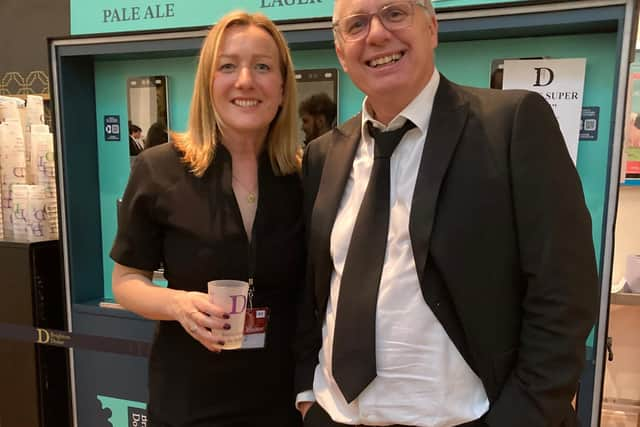
Picture: Gill Davies, Operations Director, copyright Social Firefly. Steve Warner, Principle Double Bass, copyright Janet Lawrence
Next concert: Saturday, November 8, Corn Exchange 7.30pm. Britten’s Serenade with tenor Mark Padmore. Tickets: 01273 709709 or at Brighton Dome Box Office. Concessions for joining the Under 30s Club and other criteria to check on. And on the door on the night.