
Packed Petworth screening hears stark climate warning
See the latest news from Your World at https://www.sussexexpress.co.uk/your-world
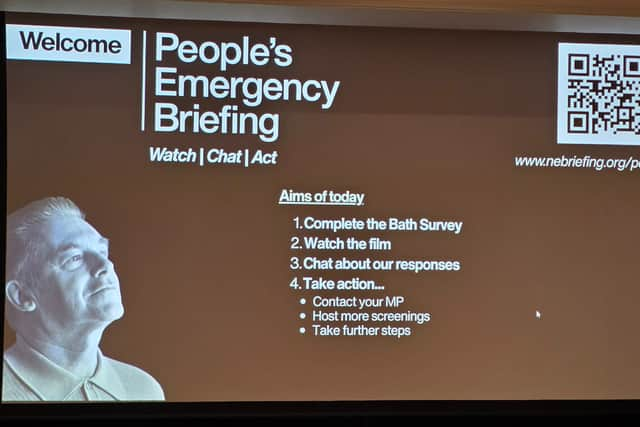
Climate change is “getting worse fast, and we are not prepared” was the message delivered to a packed Leconfield Hall on Monday night, as residents gathered to watch The People’s Briefing. It is a film fronted by Chris Packham and based on a presentation delivered to MPs by climate experts, former military personnel and medical professionals in Westminster last November.
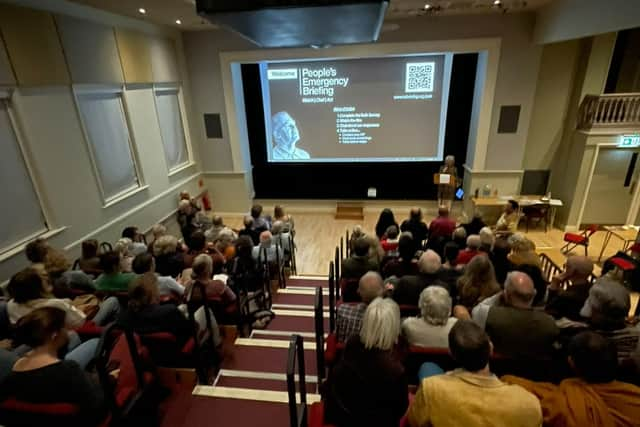

The Petworth screening came at the end of what has been the hottest and driest summer on record; a season in which local farmers struggled with poor harvests, St Richard’s Hospital worked to keep patients and labouring mothers safe in extreme heat, and ambulance crews saw a record number of callouts. Yet, the film makes clear that “this is as good as it is going to get for a long, long time.”
Across 50 minutes, the briefing sets out in stark terms how climate change is expected to affect every part of British life - from national security and food supply to health, infrastructure and insurance.
The filmmakers argue that “despite the scale of the risks now facing the UK, there has been no comprehensive national emergency briefing delivered to the public by the Government.”
Their aim is for communities to watch the film together and feel equipped to push for change, with the hope that it will eventually be broadcast on network television, similar to the government addresses during the Covid pandemic.
Chris Packham watches the 2025 briefing alongside a panel of celebrity guests like Jennifer Saunders and Deborah Meaden and a cross-section of ordinary people.
The film is interspersed with news footage and interviews. Chris Packham's role feels almost Cassandra‑like, warning of an impending “systemic breakdown,” yet conscious that those warnings may not be heeded.
The briefing explores eight themes, including extreme weather, national security, food security and health. Viewers are told that one in four homes could become uninsurable due to flooding risk, a warning echoed this week by Aviva chief executive Amanda Blanc, who said the firm’s research shows nearly a third of new homes built in 2024 will be at risk of flooding by 2050.
Professor Kevin Anderson, Zennström Professor of Climate and Energy at Uppsala University and Chair of Energy and Climate Change at the University of Manchester, tells the audience that the stable climate underpinning modern societies has already changed to become unpredictable.
CO₂ emissions, he says, have risen so sharply that we are “looking at unprecedented societal and systemic collapse.” He adds: “Physics doesn’t care about politics.”
He is followed by Paul Behrens, a sustainability scientist and British Academy Global Professor at the Oxford Martin School, who explains that a third of food inflation is now driven by climate change. He notes that solutions exist, from adopting more plant‑based diets to reducing imports and supporting British farmers to grow more crops, all of which could help mitigate the effects of global food shortages.
The film also highlights the UK’s declining biodiversity, pointing out that despite the Brits love of the countryside, we live in one of the most nature‑depleted countries in the world, with one in six native species at risk of extinction.
As the screening continued, frustration grew both on Packham’s panel and in the Petworth audience. “I am going to start to lobby my MP,” said Jennifer Saunders on screen. “Something I have never done before in my life.”
Expert after expert outlined the potential impacts of climate change on everyday life, from pressure on the health service to increased security risks, but the film also emphasises that there is hope.
Solutions exist, and many are already being deployed. Half of China’s energy is now renewable, the film notes, reminding viewers that “sun and wind are free forever.”
The transition to net zero, it argues, is becoming more affordable as technology scales, and will ultimately benefit both the economy and the planet.
At the end of the screening, organiser Beverly Exall invited the audience to reflect. As the microphone moved around the hall, residents voiced anger, worry and a desire for political action.
“People want change,” said one woman, “but politicians of all parties don’t seem to want to do anything about it.”
“We are contributing to our own demise,” said another. One attendee said they were “terrified and incredibly angry that our politicians aren’t taking this seriously. We need to change our politics.”
When asked which politicians had seen the film, Mrs Exall said she and others had invited local MP Andrew Griffith to this and other screenings. “At present our MP has not supported the Parliamentary Call, nor accepted any invitations to watch a community screening of this film.”
The announcement prompted loud boos, with one resident adding: “I sat here listening to Andrew before the election, and there were only three rows filled. Today this hall is packed. He should be here.”
What seemed to fuel the audience’s frustration was that the film ends on a note of cautious optimism. Economist Angela Francis and energy transition campaigner Tessa Kahn outline practical steps already being taken around the world, showing that many of the risks highlighted in the briefing can be reduced if action is taken quickly.
The message from the room was clear: residents want reassurance that the voices of those who profit from fossil fuels, or deny the reality of climate change, are not prioritised, and they want politicians and policymakers to consider investing in and supporting the available solutions.
As Jennifer Saunders put it, “If we can invent AI, why can’t we work out a way to sort out our s*** without it polluting our rivers?”
In the Leconfield Hall, at least, the appetite for action was unmistakable, and there was a real sense that communities must push for change themselves.
Andrew Griffith has been invited to comment but had not done so by the time of publication.