
Peacehaven man training for Paralympics thanks medical teams for life-saving treatment after fall at Brighton seafront

A Peacehaven man who fell ten metres at Brighton seafront has been reunited with the medical teams who gave him life-saving treatment and supported his early recovery.
Noah Rees was 18 years old at the time of his fall in May 2019 and suffered a fractured skull and spine, as well as brain injuries and damage to both lungs.
Noah, who was training to be a professional rugby player, was taken to Royal Sussex County Hospital in Brighton, which is part of the University Hospitals Sussex NHS Foundation Trust.
UHSussex said he remained in a coma for six weeks in intensive care before he was transferred to the neurosurgery team who helped his early recovery.
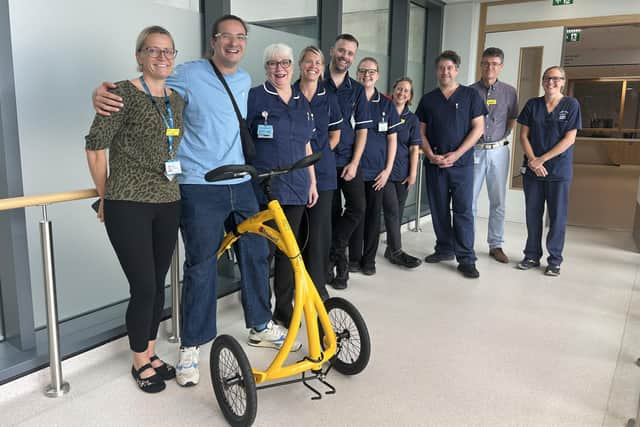

The Trust said Noah visited the Royal Sussex on Monday, September 14, to meet hospital director Stephen Mardlin, as well as clinicians from the neurosurgery and critical care teams who helped him.
Claire Frampton, Junior Sister on the Neurosurgery ward, said: “It was so special to see Noah again and to see just how far he has come since we cared for him all those years ago. When Noah came to us, he was still seriously unwell and unable to speak, but we felt he was trying to communicate with us. Even at such a difficult point in his recovery, we could see his personality coming through and I remember his amazing sense of humour beginning to show.
“What also really stood out was his determination to recover. To see him back here seven years later, having regained so much of his independence and now competing in sport and working towards such an ambitious goal, is wonderful.”
The Trust said Noah made ‘significant first steps’ in his recovery on the neurosurgery ward before he received further specialist rehabilitation in Putney. The Trust said Noah has now made ‘huge strides’ in his recovery after seven years. He can walk, talk and eat again and does competitive frame running for Lewes Athletic Club, alongside training to qualify for the 2028 Paralympic Games.
During the visit, Noah was given a tour of parts of the hospital, including critical care, neurosurgery, the sanctuary prayer and reflection space and the helipad.
Noah said: “It was amazing to meet some of the clinicians who saved my life and cared for me when I needed it most. I’ve wanted to thank them properly for everything they did for me, although I don’t think I could ever thank them enough. By the end of the visit, I had to say I’d better go before I started crying – it was a really lovely, life affirming and also an emotional moment.”
He said: “As a result of all the work I’ve put into my recovery I’ve been able to get back into sport and start training in frame running. That has been incredibly liberating for me. Having that independence and something I can work towards means a huge amount. I know I’ve still got a lot of work to do to get to the Paralympics, but it’s great to have something to aim for. I think everyone needs something they’re passionate about to work towards in life – and that’s what sport has become for me.”
During his first year of frame running training, Noah cut about 15 seconds off of his personal best. He then improved by another five seconds in the second and third years. The Trust said Noah now only needs to cut 2.5 seconds from his personal best to put him in contention for the 2028 Paralympics.