
Reports of 'tornado' on Littlehampton seafront - dust devils explained

Reports emerged on social media last week of a suspected ‘tornado’ in Littlehampton.
Jade Cope recorded a video (embedded in the article) of a tornado-like phenomenon swirling across the seafront’s East Green on Friday (July 31) afternoon.
Weather-savvy locals quickly identified it as a dust devil – a spiralling, dust-filled vortex of air.
Jade said: “I had never seen one myself. It was cool.”
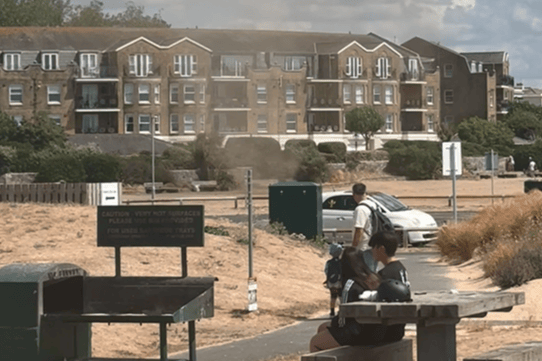

The Met Office said dust devils mainly occur in desert and semi-arid areas, ‘where the ground is dry and high surface temperatures produce strong updrafts’.
Although they resemble 'mini-tornadoes', dust devils ‘are nowhere near as powerful or destructive’, according to the Met Office, though there have been rare occasions where they have caused damage, and even deaths, in the past.
A Met Office spokesperson said: "Unlike tornadoes, dust devils grow upwards from the ground, rather than down from clouds.
"In the stronger dust devils, a cumulus cloud can be seen at the top of the rising column of warm air.
"They only last a few minutes because cool air is sucked into the base of the rising vortex, cooling the ground and cutting off its heat supply.”
Torro, the UK's Tornado and Storm Research Organisation, said prolonged dry and warm conditions are ‘helping to fuel’ the phenomenons. Monday (August 3) may be ‘particularly ripe’ for further reports of dust devils in the south, according to the group.
Torro said anyone who witnesses the weather event can report it at: www.torro.org.uk/severe-weather-report.