
The Royal Pavilion, Brighton - a "building which plays with your senses"
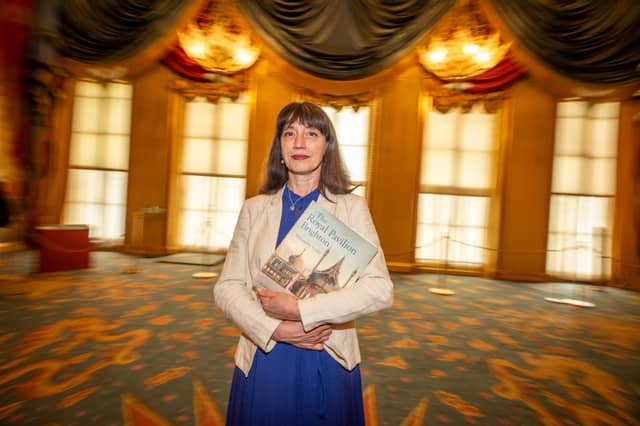

Royal Pavilion curator and colour historian Alexandra Loske says she feels she is standing on the shoulders of giants as she adds her own volume to the literature on the iconic Brighton building.
She is hoping her new book The Royal Pavilion, Brighton: A Regency Palace of Colour and Sensation (Yale University Press) will stand for a generation at least – the first major study of the palace in 40 years.
The 272-page book, illustrated with more than 250 colour images, including brand new photography and Georgian-era watercolours and drawings published in full for the first time, brings to life the colourful designs of King George IV’s seaside pleasure palace, from his obsession with silver to his love of all things fantastical and opulent.
Alexandra said: “There have been other books about the Royal Pavilion, really, really good books but nothing in depth for quite some time.”
Alexandra completed a PhD on the Royal Pavilion and this has been a starting point for the current book: “It's partly based on the thesis but it had to be up to date and it had to be accessible.
“My way into it was mostly focusing on the interiors as they would have looked when the Pavilion was first created for George IV. I wanted it to have a new approach, my approach, and the approach had to be different to guide books so I decided to focus mainly on the interiors and of course the colour and how it was decorated in the period of its creation. I wanted to focus on the building in 1820 and so I used a lot of archival resources but not just account books and inventories. I also used some really fascinating images.
“We know a quite a lot about the 1820s interiors. It was the peak time for the Royal Pavilion when it was looking the way that George IV wanted it to look. He had become King and Napoleon had been defeated and the best people were involved. I wanted to look at all the gorgeous images of that time but to set the whole thing in its historical context.
“I have been here for so long as a researcher and a curator that I have been discovering things all along the way, the kinds of things that you only learn when you have been in a building for a long time, from other authors but also just simply from being here. But really I want to go back to the primary sources and I really wanted those images to be in the book. Many of them have been published before but many have not.”
Inevitably this is not the last word on the building: “The building holds lots of secrets. There is so much that we don't know about it, and I am aware of being one of many in history that have written about the Royal Pavilion. Hopefully this book is the book for this generation but I'm conscious that there have been many before me and I do feel like I am standing on the shoulders of giants.”
But it certainly doesn't exhaust Alexandra's fascination with the building: “In a way the building was given to me. I moved to Brighton. I loved history and historic buildings but I was quite puzzled by this building for many years, and then I applied for a PhD scholarship and I was asked to look into colour in Regency and this building. And it just really became a bug. As I hope I've written quite entertainingly, it is a building that really plays with your senses. It's a building that draws you in and it's a building that absolutely still fascinates me.”