
Hastings retro with Steve Peak: Hastings in 1966
See the latest news from Your World at https://www.sussexexpress.co.uk/your-world
In last week’s Observer I described the launch in 1966 of the Hastings Embroidery, now on display in the town hall until the end of October. The making of the Embroidery was just one of many events around the town commemorating the 900th anniversary of the Battle of Hastings in 1066.

But there were many other notable happenings in the borough in 1966. Early in the year, Breeds Place, a striking six-storey terrace on the seafront, built in 1828 as an extension of Pelham Crescent, was demolished. It had brought a major upgrade of the town as an attractive seaside resort in 1828. It was built by landowner James Lansdell, who named it after his new wife Miss Martha Breeds, a member of the influential Breeds family.
Around 1960 the hotel and flats at Nos 1-6 Breeds Place had been bought by a speculator, and the occupants then moved out. For the next five years they were all empty and became increasingly derelict while Hastings Council discussed rival planning applications for their demolition. Then in late 1965 the Council gave permission for a six-storey office block, with shops on the ground floor. Demolition began quickly in January 1966 and the new block was up and running by early 1967. It is now Muriel Matters House, headquarters of Hastings Council.
Also in January 1966, more than two years after a public inquiry was held in September 1963, local residents around the Pinders/Tile Kiln area of north Clive Vale heard that they had been largely successful in stopping large-scale development there. But the new Local Plan now being put together by Hastings Council has revived the scheme, and also the opposition to it.
On May 24 the Triodome on Hastings Pier housing the Hastings Embroidery was opened by Princess Alice Countess of Athlone. The Triodome was a large circular exhibition hall on the parade extension, It took over the space used since 1961 by a moveable bandstand, which was then taken to Warrior Square gardens. The Triodome cost about £12,000 and from 1967 was used for a variety of amusements. It is now on Brighton Pier.
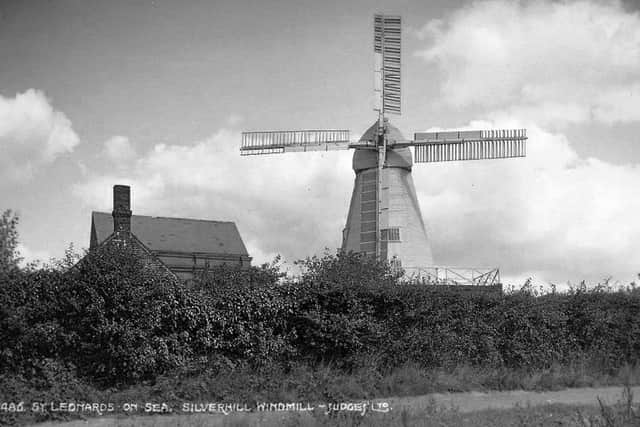
In the summer of 1966 the town’s last windmill, Draper’s Mill, at Silverhill, was demolished because of its poor condition. Once there were 16 windmills standing on various hills and uplands around the town. The Draper’s Mill was built in 1866 on the site of a mill that had burnt down in 1865. It last worked in 1941 and was left to decay from then on. It stood on the north side of Windmill Road, behind the houses. There are no remains of it.
From early August through to December there was much anti-British vandalism in the town, consisting of white emulsion slogans painted in French on many buildings and graves. The grounds and walls of Hastings Castle had slogans including ‘Harold was a Coward’, ‘Hastings Stinks’ and ‘You are Our Slaves’. Also targeted were Battle Abbey, St Andrews Church, the Alexandra Park war memorial, the cricket ground and headstones in the Borough Cemetery.
Also in early August, Summerfields School on Bohemia Road closed as a private prep school following the purchase of the 47 acre Brisco estate by Hastings Council. Its contents were auctioned on 6 August. Over the following years, the estate (from the Museum to St Pauls Road) was redeveloped as a ‘civic centre complex’, with police, fire and ambulance stations, law courts, a sports centre and some Council offices. The school was used as an extension of Tower Road School until mid-1972, and it was demolished early in 1973.
On August 22 a well-known local charity, the Isabel Blackman Foundation, was set up. Miss Blackman gave £200,000 to the borough, “the town I love”, she said in a BBC broadcast. The aims of the charity are to provide financial help to the people of Hastings in areas which include education, Christian religion, social well-being, health and caring for the elderly and disabled. She had inherited her money from her father, Arthur Blackman, a leading local coal merchant, who set up the Arthur Blackman Clinic in Battle Road.
August 1966 was a busy month. On the 23rd the hovercraft that had been running pleasure trips off Hastings beach broke down on the sea and had to be rescued by the lifeboat. The Britannia had 35 passengers on board and was stranded off West St Leonards when two oil seals broke, causing the engine to stop.
To mark the 900th anniversary of the Battle of Hastings, there were many celebrations over the weekend of October 15-16, including a re-enactment of the battle in the fields at Battle Abbey. On October 28 the Queen and the Duke of Edinburgh visited the town, viewing the pier's Triodome and unveiling the plaque for the newly-built College of Further Education in Archery Road.
In late November it was announced that the famous old Castle Hotel in the south-west corner of Wellington Square, built 1818, was to be demolished and replaced by a Tesco supermarket. It was one of the oldest hotels in Sussex, but its structure prevented it being modernised with lifts to all floors and bathrooms in every bedroom. Tesco moved from here in 1979 when its giant shopping centre at Churchwood Drive was constructed. Its Wellington Square building is now Poundstretcher.
The Bourne Street Baths and Washhouse were to close, decided Hastings Council in December. They had opened in June 1865 and had played a valuable role in both improving public health in the Old Town and enabling fishermen's wives to set up laundry businesses, as a supplement to their husbands unreliable fisheries income. In 1965-66 the baths had been used 3,237 times, and the laundry 1,968 times. But the boiler and washing machine were both in poor condition, while a launderette (still running) had recently opened in the High Street and there were public baths at White Rock.
The Baths and Washhouse were created by the Countess Waldegrave, who funded and helped build many important churches and public buildings before she died in 1873. Her finances were inherited from the wealthy Milward family that she was part of. Ironically, now standing on the baths site is the Isabel Blackman Centre, named after the other female benefactor of the poor.
It was initially an East Sussex County Council day centre for older people, but it closed, was left abandoned and then put on the market. The charity Age Concern East Sussex in 2021 successfully led a a £650,000 capital fundraising campaign for the centre’s purchase and renovation on behalf of the local community. The new centre opened in 2022 to promote ‘Leisure, health, wellbeing and community’ for the over 50s. It is run by a new charity, the IBC - In Perpetuity.
There’s much more about the history of Hastings and St Leonards on my website www.hastingshistory.net.