
Hastings retro with Steve Peak: Mr Little's big reservoirs
See the latest news from Your World at https://www.sussexexpress.co.uk/your-world
The Hastings area was spared the full effects of this summer’s drought thanks to the vision of a Hastings council officer nearly a century ago. It was borough engineer Sidney Little who, soon after he was employed in 1926, saw that the residents of the town and the neighbouring countryside did not have enough water to see them through the following decades.

Until then the water supply of Hastings was mainly derived from nine bore holes in different locations, with the water being pumped to various reservoirs. This was a complicated system which meant some areas of the town might suffer a water shortage, while others had more than enough, but could not deliver the surplus to those needing it.
So in 1927 Mr Little quickly put together a plan to immediately build a reservoir that could significantly increase the amount of available water, while at the same time he would improve the mains distribution network in the town. He also then began thinking about how to construct a much bigger reservoir that could provide more than enough supplies of water well into the distant future.
In August 1929 work began on Mr Little’s first project: the ‘Great Sanders Scheme’. This involved 170 men building a dam 1,105 feet long across a valley at the Powdermill Farm, part of the Great Sanders Estate near Sedlescombe. The 54 acre Powdermill Reservoir would hold 188 million gallons of water, fed by several springs in the neighbourhood. Filling with water started on 5 November 1932, with the top water level being reached in March 1933. The water gravitated from the reservoir to the Brede Pumping Station, from where it was pumped into reservoirs in Hastings, with a new one being built on the Ridge, next to the Harrow Bridge.
Powdermill Reservoir solved the immediate water supply crisis, but Hastings Council realised in the early 1930s that more sources were needed. By then Mr Little – the ‘Concrete King’ - was very busy reconstructing most of Hastings seafront, creating Bottle Alley, laying out the Boating Lake, building the world’s first underground car parks, putting together the giant Bathing Pool and rethinking the road network in the town. But he still managed to find time to actually start investigating where a much bigger reservoir than Powdermill could be built that would provide a reliable water service well into the 21st century.
In 1936 he and consultants produced a plan to build a reservoir across the Darwell Stream, between Netherfield and Robertsbridge. The ground and streams involved were clean and free from dangerous contamination, and the land was mainly woodland and pasture, with little arable land, and few farms and dwellings, so the water from the streams being utilised could be readily purified. Darwell Stream itself ran from south-west to north-east, entering the River Rother at Robertsbridge. Trial borings of the site showed that a near-watertight reservoir could be built, as the geological formation of the valley was of Wadhurst Clay which was practically impermeable. However, when under construction, some fissures materialised and had to be filled with 6,000 tons of cement.
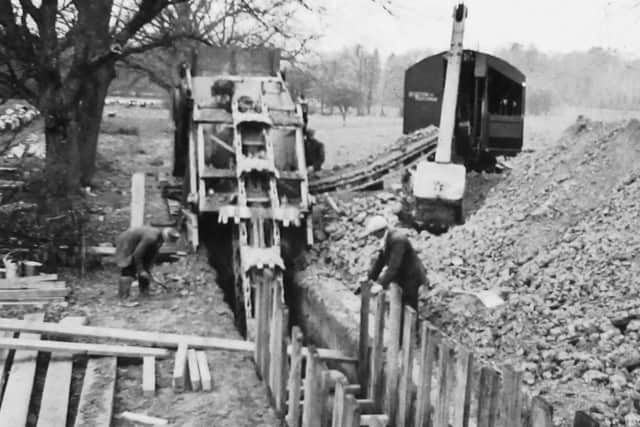
The Darwell Reservoir would cover 170 acres and hold 907 million gallons. Flowing into it through tunnels would be the Glottenham and Socknersh Streams, plus the River Dudwell and its tributaries – Park Mill Stream and Willingford Stream. An underground gravitating feed pipe would take the water from the reservoir to the Brede Pumping Station, where new plant would be needed. The pipe would be in two parts, the first being two miles of concrete tunnel at depths of up to163 feet. The remaining 4½ miles to Brede would be 24 inch diameter concrete pipes laid in covered-over trenches.
Hastings Council gave the scheme the go-ahead in December 1936, and a parliamentary bill was submitted in March 1937. The resulting Hastings Corporation (General Powers) Act 1937 stipulated that the area being supplied with water from the reservoir should include Battle, Brede, Camber, Fairlight, Guestling, Icklesham, Pett, Westfield and Winchelsea.
In 1938 work began on building the dam and creating the connection to Brede. The work was carried out by direct labour, with 150 men being employed in the early stages. There was high unemployment in the 1930s, and Mr Little tried in all his schemes to employ local men who were ‘in the queue’. He was regarded as a tough employer, as he kept a close eye on making sure the workers were earning their keep, but he was also highly regarded as a fair and sensitive boss.
However, work on the reservoir had to be greatly reduced following the outbreak of the Second World War in September 1939, because of a cutback of the available labour force and a shortage of materials. And Mr Little himself was given another job: the Admiralty recruited him to be in charge of much of the construction of the concrete Mulberry Dams to be used in the invasion of the Normandy beaches on D-Day in June 1944.
A foretaste of water supply problems in the future came in 1944, which was a year of drought, forcing Powdermill Reservoir to cut its extraction level from 500,000 gallons a day to 200,000. In 1936, when reporting on his reasons for developing Darwell, Mr Little had warned that without Darwell if there was a very dry year a few years later on, existing sources would be barely sufficient to meet demands. The 1944 situation proved just how true this prediction was.
When the war ended in 1945, Mr Little resumed work on the Darwell Reservoir. He said the pipeline to Brede had been completed but it could take several years to finish the dam and to start making the connections around the countryside. Finally, in January 1950 he was able to report that the whole project had been completed and that the reservoir was a quarter full. It was 1¼ miles long, 51 feet deep and with a catchment area of 2,382 acres. The dam was 1,860 feet long and 60 feet high.
The official opening ceremony was performed on 23 October 1950 by the Duke of Norfolk, the Lord Lieutenant of Sussex, on the reservoir’s control tower. He did this by turning a wheel which operated a valve, and so sending the first flow of water on the 6½ mile journey to Brede. It had taken 12 years of difficult work to build one of the biggest reservoirs in the south of England. It was designed to provide a supply of 3½ million gallons daily, and bring piped water to many places in the surrounding rural areas for the first time.
Mr Little retired in February 1950, but he then became Hastings Council’s Consultative Engineer, receiving the Freedom of the Borough of Hastings in 1960. He died on 1 April 1961, aged 75. He was said to believe that the Darwell Reservoir was his greatest achievement. The Hastings Observer commented: “Two great reservoirs in the hinterland created during his term of office ensured that the borough would never suffer from problems of water supply.”