
Hastings retro with Steve Peak: Steaming from Hastings Pier
See the latest news from Your World at https://www.sussexexpress.co.uk/your-world
This week has been the 45th anniversary of the last attempts to have excursions from Hastings Pier on a paddle steamer. On the three days 26-28 April 1981 bad weather stopped the Waverley, the last sea-going passenger-carrying paddle steamer in the world, from taking customers off the pier.
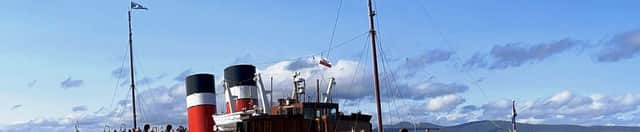

The Waverley came very close to the landing stage on those days, cheered on by a crowd of enthusiasts (including me), but the strong winds and high seas forced her to stand off. It was also at that point that it became clear that the landing stage was in a dangerous state because of lack of maintenance. Since then the stage has fallen apart and collapsed, with only a few poles still in place today.
The 240ft, 693 ton Waverley was built in 1946, and has been owned and run by the Paddle Steamer Preservation Society since 1972. She made successful trips from Hastings Pier in April and May 1978, and in May 1980, and today still goes on cruises around the British coast. From 3–12 September she will be in the Isle of Wight area, then from 24 September in London and the Thames Estuary. Details on waverleyexcursions.co.uk.
Hastings Pier was an attraction for steamboats from its opening in August 1872. Until the 1850s all piers had been not only pleasure promenades, but also jetties where travelling people could land and come ashore from steamboats. By the 1860s the railways had taken over this journey-making role for piers, but the improving design of steamers had instead made them an attraction in themselves, with high-class lounges, good catering and saloon bars.
Nearly all the steamers that have used Hastings Pier have been paddle-steamers. These are propelled by two large wheels, one of each side of the hull, with the bottom quarter-or-so of each wheel going underwater as it revolved. Paddle steamers are shallow-draught, which allows them to be used in waters not deep enough for propeller-driven vessels which have to have deeper hulls.
Hastings Pier had been built with small landing stages. But in 1886 the pier maintained its position as an up-to-date and well-liked seaside attraction by replacing these stages with much larger ones able to accommodate the increasingly popular big steamers that were taking people on comfortable cruises along the coast and across the English Channel.
The potential demand for a Hastings-based large passenger steamer had been tested in September 1884 by two local men, Richard Collard and Cllr William Paine. They were partners in the town's main fruit wholesale business, Paine & Collard, based in the Market in George Street, next to the Anchor pub. They chartered a well-known Ramsgate steamboat, the Queen of Thanet, for three weeks, and a new era began on 2 September when the 142 feet long, 159 ton steamer became the first of the big passenger vessels to work regularly from Hastings Pier. It was built on the Clyde in 1864 as the Carham, and was scrapped about 1890.
As Paine and Collard had secured a good profit from their September venture, they called a meeting of fellow businessmen on 9 October 1884 to discuss setting up a steamboat company. The Hastings and St Leonards Passenger Steamship Company Ltd was set up, and it was to be the first of a series of four locally-owned companies with similar-sounding names that ran in succession from 1885 to 1907.
The setting up of the Steamship Company prompted the Hastings Pier Company in 1885 into building a new nine feet wide landing stage on the east side of the pier that could accommodate the company’s big steamer Carrick Castle. It needed new piles and ironwork, and the work was completed in March 1886.
The pier’s new, more substantial landing stage quickly attracted large numbers of people wanting to go out on a steamer, which in turn brought more vessels to use the stage, that had been built with just one vessel in mind. Between September 1888 and August 1889 almost 732,000 people passed through the pier tollgates, the highest number till then. This prompted the Pier Company to add to the new landing stage, aiming to provide enough mooring space for four vessels at any one time. Substantial separate staging was built as a form of cap to the seaward end of the pier, measuring 285 feet in length, and connecting to the eastern stage. It was the remains of this cap that the Waverley tried to come up against in 1981.
Paddle steamer trips from the pier remained a popular attraction right up to the start of the Second World War. The operating company P&A Campbell had an office on Hastings Pier, and even as late as the week before the outbreak of war on 3 September 1939 it ran daily trips to Boulogne, two cruises to Dungeness and landing trips to Brighton, Eastbourne and Shanklin.
The pier was closed from 1940, and the first steamer to come alongside after the war was P&A Campbell’s paddle steamer Glen Gower, on a trip from Brighton on Whit Saturday 24 May 1947, the opening day of the main part of the pier. In the summers of 1947 and 1948 there were regular trips from Hastings Pier on the 270ft screw steamer Empress Queen, built 1940, and in 1948 on the 230ft paddle steamer Britannia, built 1896.
But this Indian summer soon ended, and in the early 1950s Campbell began its long journey to the graveyard, because of a change in public interest, rising costs, some management failures, a series of bad summers and the increasing trend towards private motoring. Piers in the eastern English Channel, such as Hastings, were also badly hit by new post-war landing regulations that made trips to France very difficult. Campbell managed a few trips up until 1957 but then effectively withdrew from the south coast, at least till 1969.
In August 1960 and the summer of 1961 a Hastings fishing boat, the 29ft Our Lady RX59, gave hour-long trips from Hastings Pier for ten shillings (50p). In some of the excursions the owner and skipper, Mr Manning Whiley, gave a demonstration of how to catch fish in a trawl. But these trips were not financially viable in the long term, as Mr Whiley had to pay the wages of two crewmen, and the boat could not take many passengers. The boat, built in Whitstable in 1957, was re-registered as RX16 and is now laid-up on the fishermen’s part of the beach.
P&A Campbell made a brief attempted return to Hastings in 1969 by using the motor vessel Queen of the Isles on a series of excursions, including fortnightly day-trips to Boulogne from June to 11 September. The excursion on the 11th was the last cross-Channel trip from Hastings Pier by any passenger-carrying vessel. The Waverley’s trips in 1978 and 1980 were the last steamer trips from Hastings Pier.