
Midhurst acupuncturist returns to China to continue learning
See the latest news from Your World at https://www.sussexexpress.co.uk/your-world
For local acupuncturist Paula Macklin Creasy, a recent trip to Beijing was more than a journey abroad. It was an opportunity to return to the roots of a profession that has fascinated her for over three decades.
There is something rather special about returning to the country where your professional journey first began, particularly when, 33 years later, you discover there is still so much more to learn.
I first travelled to China as a young acupuncture student, eager to understand a medical tradition that was then relatively unfamiliar to many people in Britain. That experience helped shape what has become a lifelong passion for Chinese medicine.
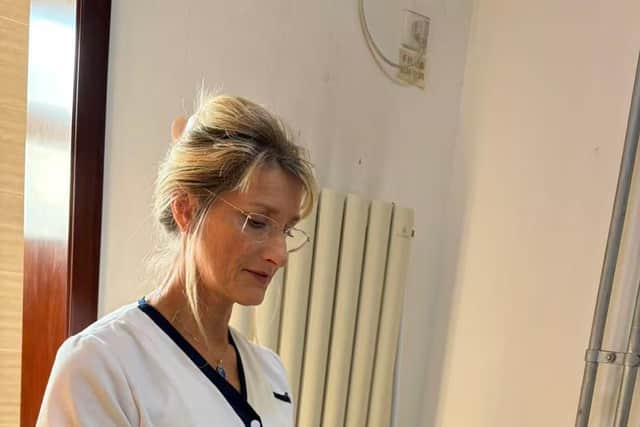

This November, I returned to Beijing to further my studies in Applied Channel Theory, an approach to acupuncture developed by the late, highly respected Chinese physician Dr Wang Ju-Yi.
One of the highlights of my visit was spending time at the Beijing Community Health Traditional Chinese Medicine Hospital, where I had the opportunity to experience Chinese medicine in a clinical setting.
What struck me was the attention given to the finer details of diagnosis and the importance of examining the body with the hands. In an increasingly technological world, there is something refreshing about a medical tradition that places such emphasis on observation, touch and careful clinical reasoning.
Applied Channel Theory takes this a step further.
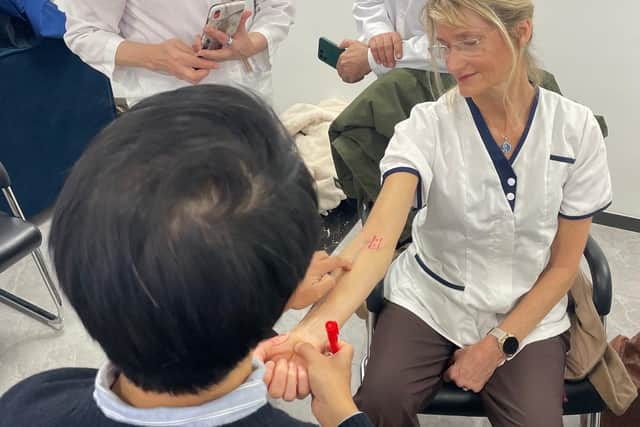
In Chinese medicine, the body is understood through a network of interconnected channels, or meridians. These form the basis of classical, traditional acupuncture theory.
Dr Wang Ju-Yi devoted much of his professional life to studying these channels and developing a practical system of examining them through palpation.
By carefully feeling along the pathways, an acupuncturist may identify subtle changes in the tissues — areas of tightness, tenderness, small nodules or differences in texture — which can help inform both diagnosis and treatment.
It is a fascinating process, rather like being a detective, gathering clues from the body that may not be immediately apparent from the symptoms alone.
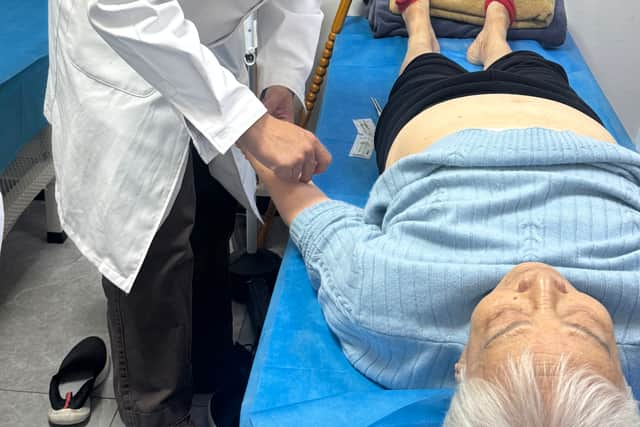
For an experienced practitioner, this approach offers another dimension to clinical assessment and a way of refining acupuncture point selection to suit the individual patient.
What I particularly enjoyed about being back in China was the sense that traditional Chinese medicine is a living, evolving practice. It is not simply an ancient system preserved in textbooks, but a body of knowledge that continues to be studied, questioned and developed.
There is also something wonderfully humbling about returning to the classroom after so many years in practice. No matter how experienced we become, there is always someone who can teach us something new.
My original acupuncture training took me to China more than three decades ago, and I have continued my postgraduate education throughout my career. Yet this recent visit felt particularly meaningful, bringing together years of clinical experience with a renewed appreciation of the traditional principles that first inspired me.
It also reminded me why I chose this profession in the first place: the fascination of trying to understand the human body, the individuality of every patient and the constant challenge of becoming a better practitioner.
Of course, there was also the pleasure of being back in China itself — a country whose culture, history and relationship with traditional medicine have always held a particular fascination for me.
I returned home not only with new knowledge and fresh ideas for my clinic, but also with a renewed sense of enthusiasm for a profession I have loved for more than 30 years.
Perhaps that is the secret to enjoying a long career: never believing you have finished learning.
Thirty-three years after qualifying, I am still discovering new ways of looking at acupuncture — and I wouldn’t have it any other way.
Paula Macklin Creasy Lic.Ac is a local acupuncturist who qualified in 1993. A member of the British Acupuncture Council, she has undertaken extensive postgraduate training in the UK and China and continues to integrate traditional Chinese medical approaches into her clinical practice.