
The unnecessary decline and fall of a seaside gem
In 2001 Green Space published, on behalf of Historic England, the ‘Public Park Assessment’ which estimated that conditions in a large number of public parks and green spaces throughout the country were in decline. Until relatively recently Eastbourne bucked that trend.
Dedicated council staff continued to achieve national ‘In Bloom’ campaign awards, Green Flag status for several of its public parks, British Association of Landscape Industries recognition for parts of the seafront and was one of only 17 public and private bodies in the UK attaining the coveted Defra Bee Champion Status for its conservation plantings.
Sadly, a lot of that has changed in the past four or five years as the local authority’s open space team has become grossly undervalued, culled and is now called the ‘Green Consultancy’. This latter despite being neither a consultancy or staffed by consultants unless hiring in expensive external ones to mitigate the self-inflicted skill shortages.
From the late 1990s the Borough Council’s Parks Department suffered several times at the hands of ever tighter budget constraints brought on by both local and national financial circumstances. Add to this the legacy of Compulsory Competitive Tendering, introduced in the 1980s, and a race to the bottom was inevitable despite the deluded belief in some quarters that you could always get the same job done for less every time the grounds maintenance contract was retendered.

In Eastbourne, skilled management with imagination and vision along with a few dedicated enthusiastic staff mitigated many of the effects of tighter and tighter purse strings. Add to this a burgeoning need to improve the environment for wildlife and adapt to the effects of climate change and the challenges add up. Sadly, at the current time there seems little evidence of a coherent solution to these challenges.
A huge talking point in Eastbourne this summer is the seafront garden called The Carpet Gardens. Until this year the colourful garden was the last vestige of the grand vision our Victorian forbears had to create a seafront with an eye-catching show-stopper of a display that would make Eastbourne one of the nation’s, if not the world’s, most recognisable resorts. Think of all those millions of postcards and photographs.
The public have recently been told that it is important that the traditional seasonal bedding and carpet bedded badges are not suitable for wildlife so have to go. This conveniently overlooks the fact that 95% of the town’s bedding has already been adapted to environmental considerations and budget cuts. It also shows a level of ignorance regarding the heritage context of the garden that originally belonged to the Burlington Hotel in the 1850s.
It was considered such an integral part of the overall design of this part of the seafront, quite rightly christened Grand Parade, that by the 1880s Eastbourne Corporation had taken over responsibility for the feature.
According to the current propaganda put out by the council in the guise of a consultation, the spring and summer bedding normally used has to be imported from the Netherlands and comes with a large carbon footprint. The corporate memory seems to be playing up again as just a few years ago the bedding was all grown in the borough and latterly was acquired from nurseries in Kent and West Sussex.
A second reason given for changing the displays to perennials is to make the area more wildlife friendly. Agreed, a few more pollinators might be attracted to some of the plants but sandwiched between a noisy road and busy promenade it is never going to be a wildlife haven. Aside from that the garden is a mere quarter of an acre in extent or, for comparison, just one four thousand eight hundredth of the area of the town’s open access downland, excluding the tenanted farms and all of the urban green space.
In concentrating people’s attention on the Carpet Gardens it has become a distraction from the deterioration and even destruction of previously successful bee beds, conservation plantings, wild flower verges and officially recognised Sites of Nature Conservation Importance (now called Local Wildlife Sites). If the Carpet Gardens are to be lost to the idea that replacing the last remaining area of bedding with perennials will have any significant benefits for wildlife this is hard to believe relative to the losses summarised above. It also extinguishes one of Eastbourne’s longest established and most famous ‘unique selling points’ as the marketing people would call it.
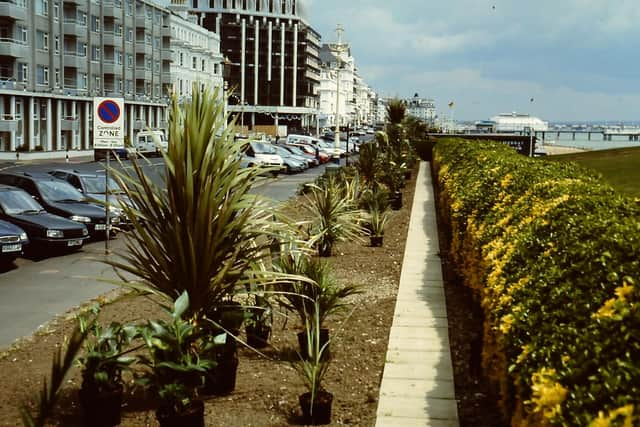
As early as the late 1990s the Parks department team had begun to modernize the planting schemes on the seafront and in some of the main parks. A previous drought and hosepipe ban in 2005 accelerated the in-house redesign of many areas with imaginative perennial schemes replacing seasonal bedding. Reducing contractor-miles, chemicals, peat use and water were all part of the equation to bring Eastbourne’s nationally and internationally award-winning gardens into the 21st century.
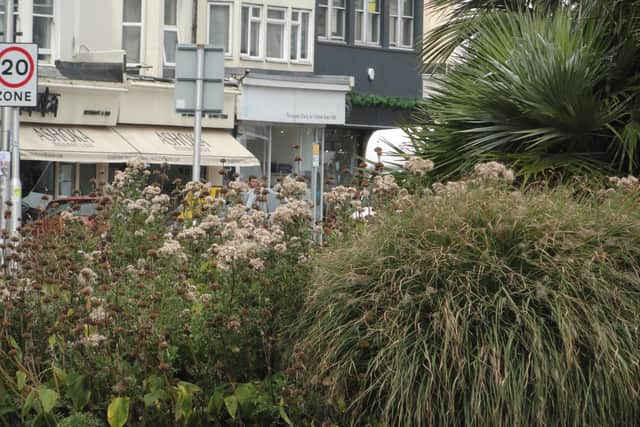
David Cameron’s “Best Value Review” also played a part in determining what was economically justifiable given the extremely important “shop window” role of the gardens to the local tourism sector. Now, often 20 years or more after planting, many of the unusual trees and shrubs that adorn the seafront are full grown elegant specimens giving year-round interest to visitors and residents.
Early on in the changes, prior to the wholesale removal of bedding, some areas such as the Long Border area in the roadside bed near the Wish Tower initially had bedding reduced 50% and the space created enhanced with ‘tropical-style’ structural planting. At the Carpet Gardens the side borders were narrowed to reduce bedding plant numbers without drastically changing the visual impact.
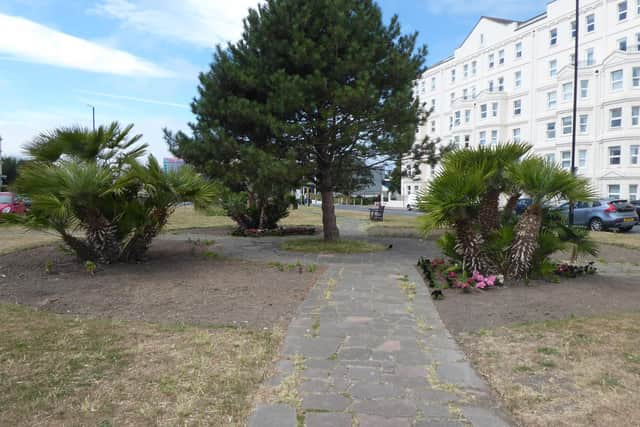
Wilmington Square, leading between the Wish Tower and Devonshire Park illustrates well just one example, amongst many, of the muddled thinking and lack of strategy driving the current deterioration of the town’s green spaces. In this square there used to be displays full of traditional bedding that were always planted and in pristine condition ready for the first major tennis tournaments of the year.
By the early 2000s the bedding was replaced with some of the award-winning bee beds previously mentioned. Most recently the established bee beds were dug out and a couple of areas sown with a wild flower seed mix. These have now been left to deteriorate as coarse self-sown weeds have begun to establish such as brambles, thistles and bristly ox-tongue. Established bee beds have also been removed from four central beds, and despite the council’s apparent keenness to be replacing bedding with environmentally-friendly perennials, as at the Carpet Gardens, it appears that bedding is being reintroduced at the behest of a volunteer group. The ‘new’ display has also remained incomplete for many weeks and probably requires the planting of around another thousand plants.
The most recent External Assurance Review of Eastbourne Borough Council, carried out by the Chartered Institute of Public Finance and Accountancy (CIPFA), makes abundantly clear the poor financial and administrative state of the authority. Even after ministerially approved bailouts (Exceptional Financial Support) totalling over £17 million, debts of over £170 million at the end of the last financial year and high interest payments, cutting and streamlining of some services is inevitable. However, CIPFA make clear that muddled administration and insufficient focus handicap future remedial actions.
The report makes numerous recommendations including diversification of the economy, wariness of reliance on volunteers (the third sector) to fulfil works previously done by contractors as at Wilmington Square, sharing opportunities and experience with other councils and better constructed contracts and improved contract management. Oddly, in month following the CIPFA report, the council’s Scrutiny Committee (16th September 2024) was informed by senior officers that “the current contract was being managed effectively and the measures in place to note and encourage performance levels within the contract were being fully utilised.” CIPFA’s point regarding the use of volunteers also relates specifically to grounds maintenance in Eastbourne.
There seems little realisation that looking after a town’s green spaces requires ‘gardening’ on an industrial scale that cannot be replaced by volunteers however keen or hard working or a weak contract.
CIPFA encourage the council to diversify the local economy in order to be less reliant on tourism as a proportion of the economy and the possible need to consider focusing on delivering its minimum statutory requirements. Being less reliant on tourism doesn’t mean reducing the tourism economy but means using imagination and efficiency to drive up the proportion of other activity along with tourism.
Recent discussions appear to show that the council has already thrown the towel in and is already cutting discretionary spending without necessarily evaluating the full impact. For local green space this has resulted in poor standards in numerous locations that make the town look run down and shabby when a large part of its appeal has always been the high quality of its outdoor environment.
Whether it’s the town centre, local parks or the seafront, these areas need to be properly looked after in order to attract visitors, reduce crime, improve health and wellbeing and increase economic activity. Taken to the extreme, in a worst-case scenario, the only statutory obligation beyond a general duty of care is to provide allotments.
Returning to the Carpet Gardens the current issues are exemplified in this one location where perhaps between £125,000 and £150,000 has been spent. The apparent absence, in the council’s mind, of a link between the town’s economy, lack of in-house imagination, expertise and ambition coupled with muddled thinking has made what is claimed to be a consultation little more than a distraction from the overall deterioration of the town’s green spaces.
If the public, with little more than partial information, are being asked to make a judgement on whether to keep the new sustainable design or revert to traditional carpet bedding they need to be better informed. For instance, apart from lacking knowledge of the history of the site, they are being asked to compare the new design with a retained area of traditional bedding.
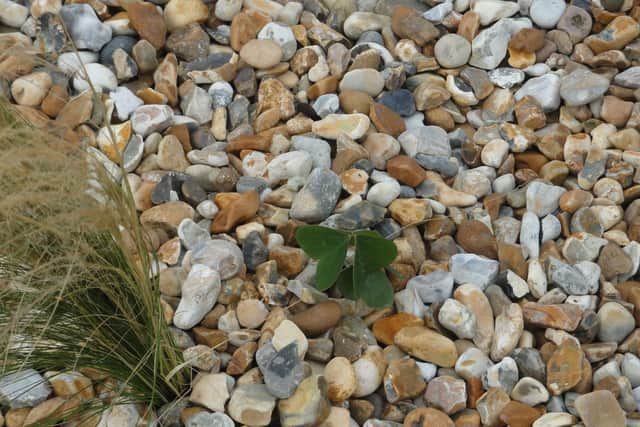
That area is unbelievably small, is partially shaded and lacks impact. Half of an adjacent small area is planted with sickly looking geraniums that were too small when they were put in late and have never recovered. Within the newly planted scheme a lot of money was spent removing around 30cm of old topsoil in order to control Oxalis, an invasive weed the removal of which was a top priority. This was tried before in 2020 when over £10,000 was invested in a similar eradication scheme. Even this time however, by the end of July it was obvious contaminated soil hadn’t all been removed and the weed was reappearing in numerous places through the shingle mulch that is self-evidently too thin.
One of the virtues of a perennial scheme is the reduction of water usage. During the dry weather, and probably for most of the new display’s first season, frequent watering was inevitable but it has taken on a strange routine. About half of each bed can be observed being watered with a hose but about half is being watered from a truck with a bowser on the back. Somehow when old waterpoints were removed the new ones were installed at the extreme ends of each area so even quite long hoses no longer reach across the site and there is a risk of plant damage hauling a longer hose across the ground.
Surely a fundamental design flaw? With regard to the amount of water the council’s gardens require, even when there was a lot more bedding, the Parks and Gardens team investigated rainwater harvesting back in the early 2000’s and although ample supplies could have been made readily available suitable investment was never forthcoming.
The high costs of the new scheme will probably be shrouded in secrecy. Perhaps not so much financially confidential as financially embarrassing. If the public disapprove are the council really going spend even more money to rip up the scheme and put the bedding back? Is the whole exercise a sham? On the face of it this could be the most expensive consultation ever carried out in the borough.
Following an amendment to the Environment Act 2021 a reporting system has been introduced obliging public bodies to have to report on what each can do to meet their ‘duty’ to conserve and enhance biodiversity. The first reporting period ends on the 1st January 2026 with the publication deadline for reports on 26th March 2026. Sadly, Eastbourne appears to be rapidly losing more wildlife sites than it is gaining. On the current trajectory the report will make disappointing reading unless praising the emperor’s new clothes is to be the hallmark of future council green space reports.
Eastbourne has reinvented itself many times over the years. Once ‘The Empress of Watering Places’ and later ‘Suntrap and Showplace of the South’ it is time again for reinvention whilst wholeheartedly embracing tourism, heritage and nature conservation. The town’s crest and motto, quietly dropped from corporate memory in recent years, says it all. ‘Meloria Sequimur’ or ‘We Aim for the Best’.