
Inside story of England's eventful first test tour of Australia, including betting battles and the entire team getting stuck in a river

Tales of England's eventful first test tour of Australia, including the entire team getting stuck in a river, have come to light amid calls for the captain, Chichester's most famous cricketer, to be remembered for posterity.
Chichester District Council has included £561,000 in its Corporate Plan for work at the White Pavilion in Priory Park, with the decision still to be made on whether it is revamped or rebuilt.
At a recent meeting of the full council, Goodwood councillor Henry Potter asked for something to be incorporated into the project in memory of the city’s most famous cricketing son, James Lillywhite.
We had an in-depth look at this Westhampnett-born cricketer's career, including captaining England at the first official test match, in the Observer in December.
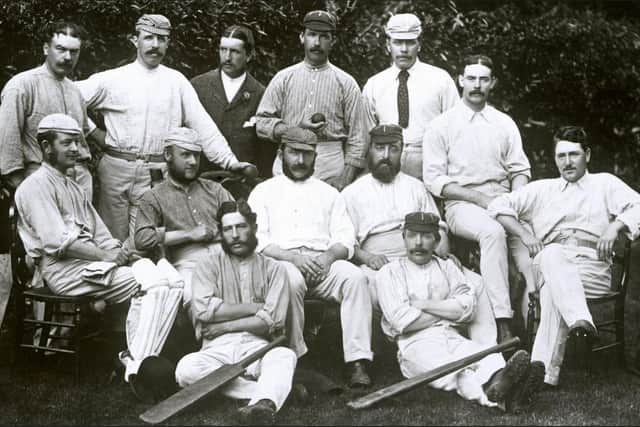

Geoffrey Simmonds has since shared further details of that first Australian test tour, having researched James Lillywhite for a Chichester Festivities fundraising dinner with a cricketing theme in 2011.
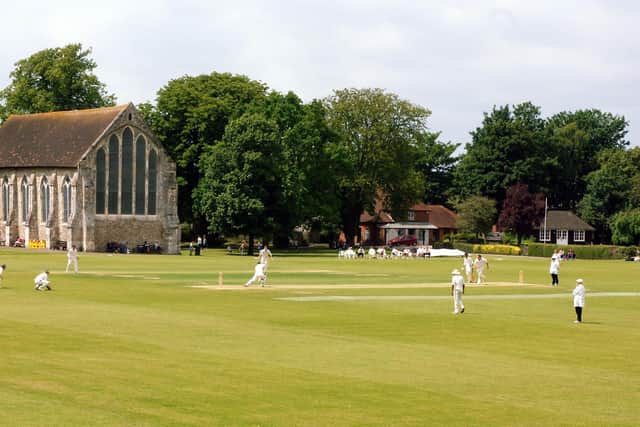
He said: "That Chichester has a seminal place in the history of test cricket may well come as something of a surprise to some. Our city has certainly never hosted a test match. On the other hand, our ground in Priory Park is a very attractive setting which has been graced by many of the game's legends over the years.
"The touring Australians played there in both 1882 and 1886, though not against Sussex – their actual opponents were a Lord March's XI and a United Eleven, one of whom was the great W.G. Grace himself. Sussex did, however, play an All-England Eleven there as long ago as 1852 and then returned to play regular county matches between 1906 and 1950."
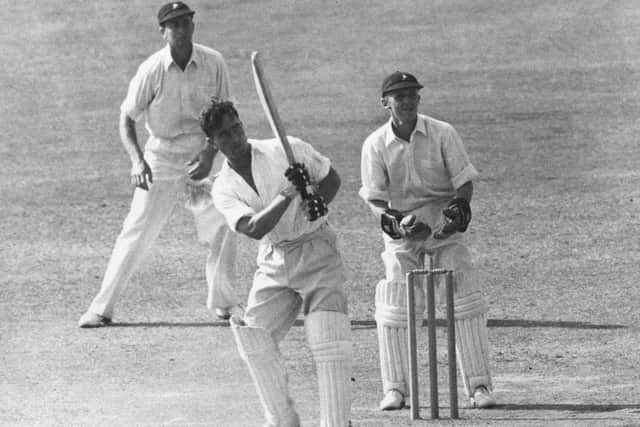
Geoffrey said his neighbour remembered going along to see England test cricketer Denis Compton but it was 'a somewhat bittersweet experience' as he was out lbw after scoring just five – and the bowler was none other than her cousin!
"Rumours of a hangover were rife," Geoffrey added. "This, I subsequently discovered, was not in a county match but a one-day friendly held during World War Two, when Priory Park played an invited Denis Compton XI."
James Lillywhite played for Priory Park and Goodwood before becoming a professional cricketer at the age of 20. His historic stature in cricket is in marked contrast to his physical height, being just 4ft 11in tall. He is, to date, the only test cricketer to have been born in Westhampnett and died in Chichester.
He was not only the organiser but also selector, manager and captain of England during the tour of Australia that included the first official test match in March 1877.
Geoffrey said: "The tour, undertaken without any specific invitation from any Antipodean cricket authority, was from the outset purely speculative.
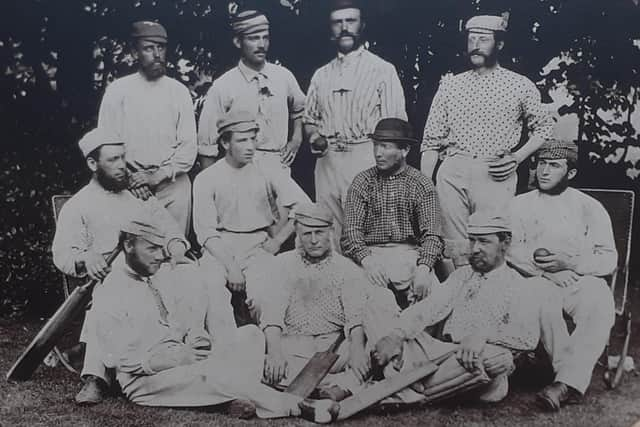
"The first match to be accorded test match status was the one played in Melbourne between Australia and England. This was largely on the basis of it being the first representative match between two international sides of only 11 players. Previously, teams had been made up of any number up to 22, and possibly more, as agreed by those involved.
"With that many fieldsmen, run-scoring was obviously far from straightforward and bowling-figures such as 14 for 22, 15 for 34 or even 14 for 12, in just the one innings, absurd-looking to our modern eyes, were quite commonplace.
"Originally, two English touring parties planned to go to Australia over the winter of 1876/7, one consisting entirely of professionals led by James Lillywhite and the other, which would also have included amateurs, organised by Fred Grace, another of the legendary Grace family. Eventually, the Grace tour was cancelled, leaving the Lillywhite party with the field to itself, so to speak.
"To say that it proved eventful is something of an understatement. The early part, taking in all the main centres in the eastern half of Australia, went relatively smoothly. It was after the Tasman Sea was crossed and during the central New Zealand leg of the tour that trouble started.
"A badly-arranged itinerary was made even worse by several hair-raising journeys. At one stage, the party's coach and horses got totally stuck in the middle of a very swollen river. The cricketers were forced to jump out of the carriage into the water, up to waist level, and, with some difficulty, drag the horses to the bank.
"With no change of clothes, they then had to light a great fire in a (fortuitously close) roadman's shelter and stand around in the altogether waiting for them to dry. An overnight landslide then blocked the road they were due to travel along, necessitating a further night's stay in their less than five-star accommodation.
"Another ever-present accompaniment to any sort of tour at this time was constant betting. So it was that Ted Pooley of Surrey, the first choice wicket-keeper, got involved in a fight over an outstanding gambling debt (in his favour) and afterwards found himself charged with assault and maliciously damaging property. Under arrest, he was compelled to stay behind in New Zealand awaiting trial while the remainder of the party returned to Australia.
"They then endured a distinctly rough sea-crossing to leave them in quite a wretched state for the aforementioned match in Melbourne, due to begin the very next day after their arrival. With all this in mind, it seems something of a minor miracle that their margin of defeat (45 runs) was as small as it was!
"Their logistical complications were still not over, however. Later in the tour, the stand-in wicket-keeper, Harold Jupp, also of Surrey, suffered what my main source of reference charmingly describes as 'a bout of insanity'. Given that there were only 12 in the party in the first place, quite how they worked round this additional difficulty is unfortunately not recorded (unless Ted Pooley was available again)."
Geoffrey shared his notes after reading our Retro article 'The Sussex cricketer who captained England at the first official Test match' in the Chichester Observer on December 25.
He said: "My main source of reference, The Complete History of Cricket Tours at Home & Abroad, lists only 12 players, with an accompanying photo, which I referred to when wondering how they coped after losing two and had only 10 left.
"I noticed, however, that the Observer photo had 13 men in it, including one R. Humphrey, not mentioned in the book. On the other hand, R. Humphrey is clearly wearing a jacket, suggesting he may not actually have been a player – scorer, perhaps? Or perhaps he ended up playing in the emergency situation?"
Some descendants of the Lillywhite family were present at Geoffrey's talk. It was pointed out that the previous generation to James had also been prominent in the cricket world, in particular his uncle William, whose influence in the game's law-making included a successful campaign for roundarm bowling to be deemed acceptable.
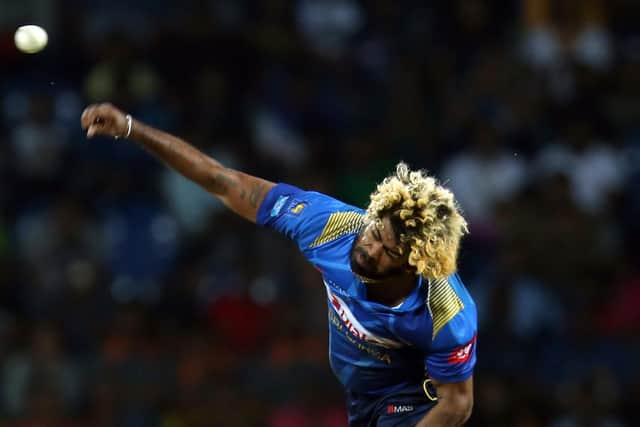
This style was in vogue at the time, having largely superseded underarm bowling by the 1830s, but fell into decline after 1864 when the current style of overarm bowling was legalised. Sri Lankan cricketer Lasith Malinga, one of the greatest limited overs bowlers of all time, was known for this distinctive style before he retired in September 2021.