
Sussex Heritage: Easter - a pilgrimage towards forgiveness and hope

Easter in the Christian tradition marks a pilgrimage through Lent, Good Friday and Christ’s crucifixion to Easter Sunday and Jesus’ Resurrection. It speaks of radical love, forgiveness and hope. These themes are given powerful voice in Graham Sutherland’s paintings of the Crucifixion and Resurrection of Christ.
Sutherland’s 1947 version of the ‘Crucifixion’ from the Hussey Bequest is displayed at Pallant House Gallery. It illustrates the artist’s obsession with thorns as metaphors for human cruelty; their jagged lines are reflected throughout the composition. Sutherland acknowledged the influence of photographs taken by the American military in the Nazi concentration camps of Jews at Belsen, Auschwitz and Buchenwald on his Crucifixions remarking “many of the tortured bodies looked like figures deposed from crosses”. His 1947 Crucifixion depicts Jesus’ body hanging lifeless on the cross. The shocking red of Christ’s blood is accentuated by the fertile green. There is agony in the body’s posture, the weight clearly visible in the angular shoulders, chest and distorted stomach. This is a God who understands and shares in human suffering. Graham Sutherland, a Roman Catholic, was sustained by his Christian faith all his life. His Crucifixions reflected people’s experience of evil in the world and yet spoke loudly of the triumph of hope in response to the tragedy of violence and war. They sadly resonate with our own times.
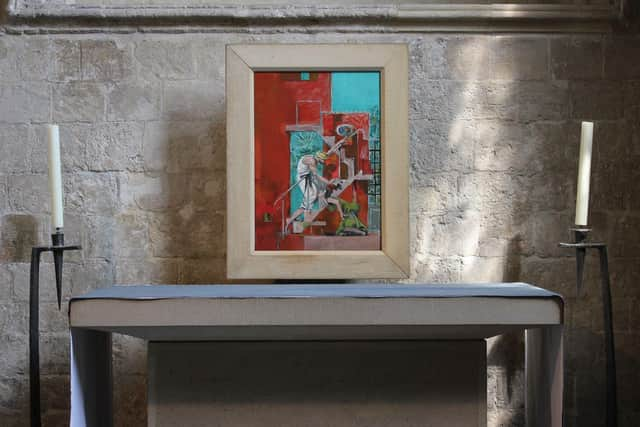
Graham Sutherland’s vibrant oil on canvas ‘Noli me tangere’ of 1961 was commissioned by Walter Hussey for the St Mary Magdalene Chapel in Chichester Cathedral. The painting depicts the moment on that first Easter morning when Mary Magdalene becomes aware that she is in the presence of her risen Lord who has just spoken her name. As she reaches out to touch him his gesture stops her. Jesus, dressed in white symbolising his holiness and purity, points towards God the Father symbolising His presence. Graham Sutherland invites us into the narrative at this liminal moment so that we, like Mary, might acknowledge Jesus, our teacher and friend, as advocate and redeemer of the whole world.
Here in the Easter story Jesus’ suffering, death and resurrection transforms the world by this radical expression of love, forgiveness and hope. It is to this example that we must turn if the world is to be healed.
There are a series of services at Chichester Cathedral in the coming days to mark Holy Week and Easter. For more information and times go to www.chichestercathedral.org.uk. To find out more about Pallant House Gallery in Chichester, visit to www.pallant.org.uk.
Rupert Toovey is a senior director of Toovey’s, the leading fine art auction house in West Sussex, based on the A24 at Washington -www.tooveys.com - and a priest in the Church of England Diocese of Chichester.