
Sussex Heritage: The Fossils Of The South Downs


The Fossils of the South Downs was published in 1822. This important book was written by Gideon Algernon Mantell, MRCS, FRS (1790-1852). His attempts to reconstruct the life and anatomy of what would become Iguanodon marked the beginnings of the study of dinosaurs.
Mantell was born in Lewes, Sussex. The fifth son of a Methodist shoemaker his education was unorthodox. From his earliest years he developed a passionate interest in geology. Expeditions to local quarries revealed ammonites, shells, sea urchins and bones which began a collection which would later be purchased by the British Museum.
He was apprenticed to James Moore and would eventually become a Doctor and Surgeon. He built a very busy and successful medical practice in those early years.
Inspired by Mary Anning’s discovery of a fossilised animal with the appearance of a huge crocodile in Dorset Mantell began to study fossils he discovered in the Sussex Weald. Always busy, he devoted his spare time to his interest in geology and fossils. The discovery of fossilised teeth in 1822 found in a Mesozoic strata caused heated debate amongst his peers. After three years the consensus of academic opinion finally joined with Mantell’s. The fossilised creature would be named Iguanodon.
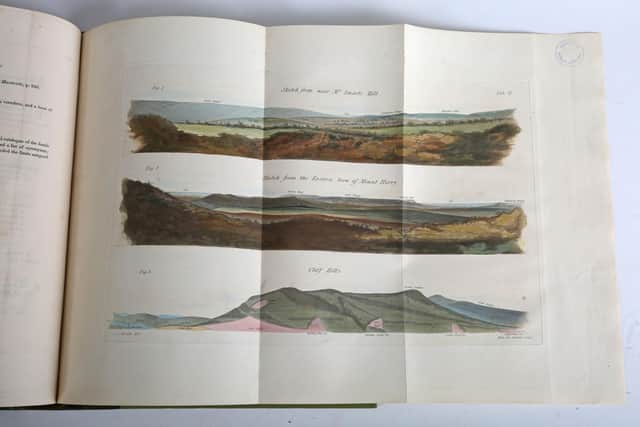
The copy of Mantell’s The Fossils of the South Downs with illustrations of the Geology of Sussex you see here was a first edition published in London by Lupton Relfe in 1822. It realised £3000 in a Toovey’s specialist book sale. It is one of a limited edition of just 25 fully coloured copies with 40 engraved plates, including two folding plates. 500 copies of the first edition were printed and only 25 were fully hand-coloured. They were sold for three and six guineas respectively. This copy was inscribed in a calligraphic hand in 1826 to Hannah Matilda, the Mantell’s daughter, who was aged four at the time. It reads ‘Hannah Matilda Mantell, Castle Place, Lewes, November 1826’ and has a five-line quote in manuscript from Byron’s ‘Childe Harold’s Pilgrimage’. Hannah tragically died from tuberculosis in 1840, aged 17. After her death, Mantell inscribed this copy to J. Foster.
The success of Mantell’s early career at Lewes and Ringmer was in marked contrast to the negative effect his subsequent move to Brighton had on his medical practice. Almost destitute, his collection became a museum in his home but was eventually sold to the British Museum. He died young, a great loss to the field of palaeontology.
Rupert Toovey is a senior director of Toovey’s, the leading fine art auction house in West Sussex, based on the A24 at Washington -www.tooveys.com -and a priest in the Church of England Diocese of Chichester.