
Mid Sussex District Council makes choice for Local Government Reorganisation
Mid Sussex District Council’s preferred choice for Local Government Reorganisation will be two unitary authorities for West Sussex.
It’s a preference that has been shared by every district and borough council in the county – but the county council voted for a single unitary covering the whole county.
The decision was made on Wednesday (September 24) by members of the cabinet following a debate involving the full council.
The preference and a business case will be sent to the government by the end of the week and then it will be a waiting game until the final decision is confirmed, likely in the Spring of 2026.
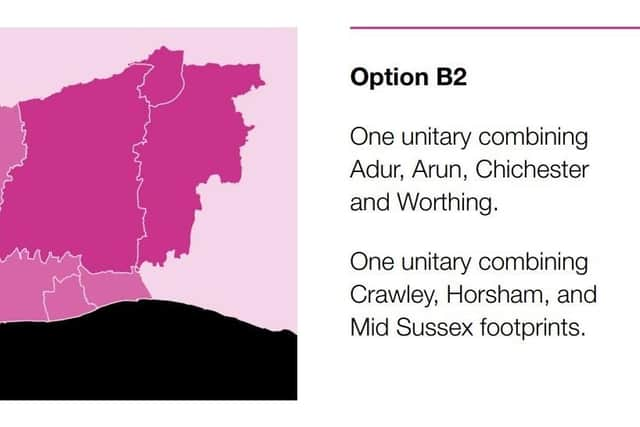

Should the government choose to go with the Mid Sussex preference, the county will be split, with Crawley, Horsham and Mid Sussex in one unitary representing 427,924 residents, and Chichester, Worthing, Adur and Arun in the other, representing 472,938 residents.
Both councils would be bigger than any London borough.
And, whatever the government decides, there will be fewer councillors representing the people of West Sussex. There are currently 358 across the county. This will drop to 96 under a one-council system or 140 under a two-council system.
Christine Cherry (Lib Dem, Burgess Hill St Andrews) said the one unitary option would ‘erode’ democratic leadership ‘by diluting the voice that individual residents will have with their councillor’.
Areas such as children’s services and adults services will fall under the control of the unitary councils – they are currently run by the county council – essentially being split in two.
This has been a major concern for councillors who support the idea of having only one unitary council.
Jim Knight (Con, Cuckfield, Bolney & Ansty) said such a move now, when resources are already strained, would be ‘folly’.
The issue of finances has long been a concern for councils all across the country with many budgets millions of pounds in deficit.
Figures in the business case said that forming a single authority would deliver ongoing annual net benefits of £48.8m, while the two unitary option would deliver £18.8m. And councils are expected to fund the £60m-£65m cost of transitioning to the new system out of their own pockets.
Leader Robert Eggleston said two unitary authorities would be in a better position to ‘transform services’ than one, would have better representation, and would be ‘strong economic entities built on sensible geographies’.
He added: “Local Government Reform is not of our doing. We didn’t request it, we’d probably rather not do it but it has been forced on us by the government.”
The two unitary option was agreed by 34 votes to zero with nine abstentions.
The government is expected to launched a consultation into the options in November.