
REVIEW - Worthing Symphony Orchestra at Worthing’s Assembly Hall
REVIEW BY Richard Amey - Worthing Symphony Orchestra at Worthing’s Assembly Hall
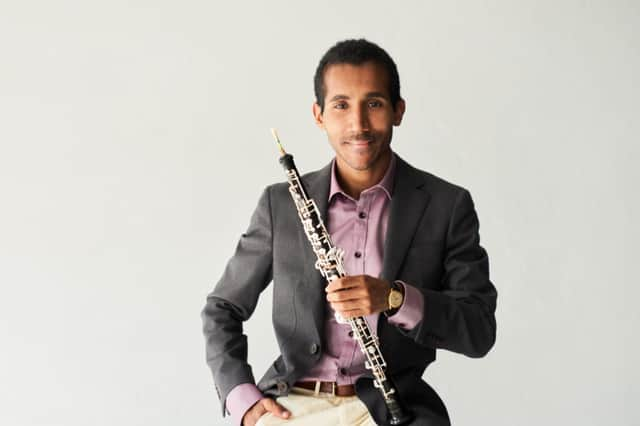
‘Enigma Variations’ concert by Worthing Symphony Orchestra at Assembly Hall, Sunday 10 November 2024 (2.45pm), leader Julian Leaper, conductor John Gibbons, solo oboe, Armand Djikoloum (Fr).

Charles Villiers Stanford, Irish Rhapsody No 1nin D minor Op78; George Butterworth, Rhapsody A Shropshire Lad; Richard Strauss, Oboe Concerto; Edwards Elgar, Variations on an Original Theme (Enigma) Op 36. Advertised ‘Piece postponed over a copyright matter’: Jessy L. Reason world premier, Lament.
UNEXPLAINED MYSTERY is the enduring game Edward Elgar still plays with us after 124 years. It probably won’t cease. He died with his tongue in his musical cheek. Plant the seed of speculation about there being “an ongoing counterpoint goes across each variation but never appears” inside your greatest and most enduring compositional idea – the Enigma Variations, his friends, wife and himself pictured within – ensure your tracks are covered, red herrings scattered, and the world forever casts around for plausible answers.
Was it an Edwardian pop tune or community song, such as the national anthem, or as later mooted, simply an unspoken concept such as Friendship? Elgar talked about “its dark saying”. With his own cheek bulging with tongue, WSO director John Gibbons on Sunday threw his own latest frivolity into the ring, during his verbal introduction to his latest reading of one of his favourite performing works.
Variation No 10 is a dear young friend of the Elgar family, Miss Dora Penny, nicknamed ‘Dorabella’ by Edward. After Nimrod concludes, she ups and dances around the room, and she speaks with a stutter, in gently lifting the atmosphere, before Hereford organist GRS’s bulldog Dan jumps into the River Wye paddles after a stick and grabs all the attention. Elgar and Wolverhampton-based Dorabella went to Molyneaux to watch Wolverhampton Wanderers, where Elgar contributed probably the world’s first football crowd chant, in salute to a favourite striker.
Mr Gibbons became a Wolves fan almost as soon as he became an Elgar one, and WSO audiences fond of his frequent onstage references to the boys in old gold and black tend to check Wolves’ latest results before venturing out afresh to his concert halls. How he would laugh off Wolves presently propping up the Premiership will have interested them this time. To his relief, their first win of the season preceded this concert. In that mood, he offered his new explanation of the Enigma, in the rhythm of its mere opening bar. A silent beat’s rest followed by the sung “Wol-ver-hampt-ton”.
In his own turn, Gibbons left the rest of the theme unspecified, but I’ll happily spark BBC Radio 5 Live debate and terrace dispute with this suggested continuation: “Wol-ver-hampt-ton, “Oh-dear-me-e”, “What-a-pity”, “It’s-V-A-R”, “That’s-their-down-fall”, (rest) “Wolves-are-for-the-drop”; and then the tune rises, brightening with rescuing optimism: “But maybe-we’ll-stay-up”, “And-go-on”, “Win-the-Cup”. ”Who-knows? . . . ” (Over to you for any more).
Gibbons’ Enigma Variations performances are automatic highlights in his 20-something-year WSO career, each latest one more interesting and satisfying. He stuck to Sir Edward’s instruction that the theme’s introduction and his wife’s picture should, in unity, share the same pace. Gibbons was not piously slow or implying intense mystery. It came like the casual original idea on his piano that his perceptive wife seized on. The four horns led by Richard Steggall bestowed a large oval frame of warmth around Lady Alice’s climax.
But this performance was not an Edwardian drawing room portrait gallery in sepia, but an affectionate parade of characters being variously hugged, teased, cherished, caricatured, to be now collectively upheld as one man’s gratitude at being socially blessed. It was large, leapingly live and in the flesh, to dwell among its five-and-half-hundred Assembly Hall listeners like no artificial disc recording doctored by engineers and other self-justifying experts.
Elgar’s nervous trio pianist dartingly flexed his fingers in urgent rehearsal readiness. The amateur theatrical mimic bounced through, smiling and amiable. The unsubtle country squire began perkily and went boisterous. The serious-then-chuckling conversationalist spread his room presence soberly-then-jovially through the strings then the winds. Ysobel’s viola bowing lesson practice might have been rather and too smooth and accomplished from WSO’s section. But the whole band revelled tightly in Troyte’s exasperation overdrive at proving himself a much better architect than a pianist.
At the Norburys’ happy household, their laughter needed a bit more of its contented string counterpoint. But it still prepared sublimely for Nimrod’s hush of expectancy. After hearing this music privately from Elgar on the piano before its release into the world, Dorabella wrote that she detected the portrait of a wonderful person. The composer and the German-blooded August Jaeger, Elgar’s champion “of grand and noble mind” inside the less-convinced publishers Novello, had been discussing the workings of Beethoven’s mind (“He never gave up” – Jaeger), a conversation that inspired Nimrod. But we can now spot Dorabella pinpointing instinctively for us the profound and career-saving and shaping affect Jaeger had on Elgar.
Gibbons carefully built the piece like an inexorably swelling sea which poured into a wonderfully rounded and warm climax and fade.
After Dorabella’s stutter was uncannily articulated by WSO, and Dan had dried himself off with his violent shake, Andrew Kershaw’s tuba was accentuated by Gibbons – as Elgar may have hoped, but mamy other interpreters miss this instrument’s character-depiction potential. Section leader Miriam Lowbury briefly bookended Basil Nevinson’s great, core Variation 12 and her cello section played it with care and a degree of (Edwardian?) reserve, rather than deepened affection.
Two Variations left and Gibbons had a new hypothesis about the much-speculated *** Romance. As the unidentified ‘soul’ in his Violin Concerto – to my mind surely his ‘windflower’ woman, Lady Alice Stuart-Wortley – the departing voyager Lady Mary Lygon has been the popularly assumed depiction. Gibbons, while reminding us of this (intriguing number) Variation 13 theme’s kinship with Mendelssohn’s Calm Sea and Prosperous Voyage, indicated it also matches Robert Schumann’s Piano Concerto. And that Elgar had a likely certain female piano pupil who could be another object in his heartthrob cupboard.
Twin clarinets, Ian Scott and Chris Goodman, were unfailingly the satiny feminine sonic stars of this Variation and timpanist Rob Millett followed Elgar’s sound effect for Lygon’s ocean liner engines using the prescribed two finger-held half-crown coins, in a roll on his drumskin. Millett and bassoonist Simon Chiswell were frequent highly honourable mentions as Elgar fully intended.
WSO’s tuba also enhanced the Finale – Elgar’s growingly confident, even ebullient self-portrait – which Gibbons grew to a pitch of near-Tchaikovskian festivity that will have imprinted his overall interpretation on his listeners’ memory, until the next time.
Another self-portraiting great composer was Richard Strauss, a fellow Gemini, whose Oboe Concerto pairs with Metamorphosen in a recent new composer interest on Gibbons’ WSO performing CV. Both are late Strauss, needing patient absorption through several listens, but the Oboe Concerto joins with Four Last Songs in his late-life worship of the full-range soprano voice.
As Enigma Variations was here a Gibbons phenomenon, so in the Strausss was emerging young Parisian oboist, Armand Djikoloum. His was the agility, the fluidity, the silk-edged tone, the control of the long lyrical line so-loved by the composer, and the conscious interplay between himself and other duetting instruments or orchestral sections, that Strauss needs. In execution, pencil-slim, black suit, classy dark grey open shirt, he stood on a sixpence, swivelling his body towards audience, conductor and orchestra members, and had rotated his oboe eventually through all degrees of the circle.
Solo oboe concertos down WSO history scarcely number even a handful. Soloists get few symphony orchestra opportunities with the Strauss or Vaughan Williams Concertos and instead have to spend staple earning time inside orchestras or in chamber music. Djikoloum is with Chineke! and Kaleidoscope Chamber Collective. He duos with Jordanian pianist Iyad Sugayev, guests in European and Scandinavian orchestra principal positions, gives conservatoire oboe masterclasses, and his most startling facet is his presence this year in the all-from-memory Aurora Orchestra in their BBC Proms and other performances of Beethoven’s “Ninth by Heart”.
After his warm Worthing ovation, I asked him if he saw himself in the Strauss Concerto as portraying three operatic soprano in the three movements. His reply was that after performing Strauss opera this year at the Stuttgart Staatsoper, he detects more different characters in there than that. In parting, I asked him if the automatic bottle of wine he received onstage after his performance was his native French. He confided that he doesn’t drink.
WSO have recently given solo concerto spots to their own wind players – horn, four horns, clarinet, cor anglais, flute & harp – and this, some people hoped, might have been the day for principal oboist Chris O’Neil. I don’t know any repertoire or availability circumstances, but Mr O’Neil was not in the orchestra on Sunday.
As a Remembrance Sunday concert, a rhapsodic and reflective opening feeling was set by a minor-key Stanford piece whose scurrying string parts proved a stern test, and then another, by one of British World War I loss George Butterworth’s two elegiac works most frequently appearing and appreciated on this day on the calendar.
Richard Amey
Upcoming local concerts
Saturday 16 November – Worthing Choral Society, ‘Reflection, inspired by beautiful music’, 7.30pm at St George’s Church, Worthing BN11 2DS; associate musical director Sam Barton, musical director Aedan Kerney, soprano Natalie Clifton-Griffith, tenor Sam Barton, organ and piano Philip White-Jones.
Sam Barton, In Flanders Fields (premiere); Ola Gjeilo, The Ground; Eleanor Daley, In Remembrance; Mack Wilberg, Amazing Grace; Eric Whitacre, Lux Nova; Howard Goodall, Eternal Light.
Sunday, November 17 at Regis Music School, Sudley Rd, Bognor Regis PO21 1ER, 3pm: Piacere Piano Quintet. Samuel Coleridge Taylor in G minor op 1, Camille Saint-Saëns No 1 in A minor Op14. Tickets via EventBrite or on door.
Sunday, November 24 at Assembly Hall, 3pm: ‘Orchestral Transformations’ – Worthing Philharmonic Orchestra, leader Adam Barker, conductor Dominic Grier. Stravinsky, Firebird Suite; Liszt, Piano Concerto No 1 (soloist, Katya Grabova); Bartok, Concerto For Orchestra. Tickets from wtm.uk or on the door.