
Does the new Met Office fog warning cover Sussex?

Dense fog is forecast to return to parts of England on Monday evening, with the Met Office warning of difficult driving conditions and possible disruption to Tuesday morning journeys.
The yellow warning runs from 6pm on Monday (November 9) until 10am on Tuesday. Fog is expected to thicken overnight, cutting visibility to below 100 metres in places, before thinning and clearing during Tuesday morning.
Road journeys could take longer, with possible delays to buses and trains and a chance of flight delays or cancellations. The Met Office advises travellers to check with their operator before leaving, including those booked on ferries. Drivers should check road conditions, allow extra time and make sure their fog lights work before setting off.
The fresh alert follows a separate warning that ran from 6pm on Sunday to 11am on Monday, when visibility was forecast to fall to 50 metres or less in some places.
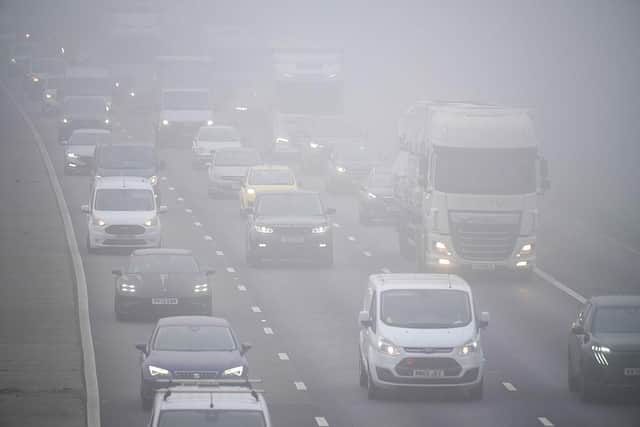

Sussex was covered by that earlier alert but falls outside the latest overnight warning area.
The latest fog warning covers a large part of the UK, but no further south than Luton. In the north, it reaches as high as the East Riding of Yorkshire.
The Met Office advises checking the local forecast before travelling, as weather warnings can change.
How to drive in dense fog
Drivers should leave more room behind the vehicle in front and check that their dipped headlights are on, as automatic lights may fail to activate in fog. The Highway Code requires headlights when visibility is seriously reduced, generally when drivers can see no more than 100 metres ahead. Fog lights may be used in those conditions and must be switched off once visibility improves.
Edmund King OBE, director of the AA Charitable Trust, said: "Fog can transform a familiar road in a matter of minutes, and with visibility potentially falling to just 50 metres in some places this morning, drivers need to be prepared to adapt their speed and leave more room between themselves and the vehicle ahead.
"One of the biggest mistakes is simply following the rear lights of the car in front. It can give you a false sense of security and means you may be travelling too close to react safely if that vehicle suddenly stops.
"Don't assume your automatic headlights have switched themselves on either. Take control, use dipped headlights and make sure you can both see and be seen.
"If visibility becomes seriously reduced, use your fog lights, but remember to switch them off again when conditions improve as they can dazzle other road users and make brake lights harder to distinguish.
"Ultimately, there's no prize for arriving a few minutes early. Give yourself extra time, slow down and drive to what you can actually see ahead."
Matt Crole-Rees, a car insurance expert at Confused.com, also gave some useful advice.
He said: “When weather conditions bring light winds, clear skies and long nights, they create the perfect conditions for thick fog. This can make even a familiar route feel daunting, cutting your visibility and making it much harder to judge distances.
"Our research shows more than half (51 per cent) of drivers find dense fog one of the conditions they struggle most to see clearly in. When visibility is this low, the key is to slow down, so you’ve always got time to stop if you need to."
Mr Crole-Rees said fog is ‘one of the trickiest conditions to drive in’. He gave a few ‘simple steps’ to help drivers ‘stay safe until it clears’:
– “Drop your speed and leave extra space behind other vehicles, as reduced visibility means you may not see hazards until it’s too late to stop;
– “Use dipped headlights, and fog lights only when visibility drops below 100 metres, switching them off as it clears;
– “Avoid full beam, as the light reflects off the fog and makes it harder to see;
– “Use your wipers and demister to keep your windscreen clear, as fog leaves a film of moisture on the glass.
– “If the fog gets so thick you can’t see safely, find somewhere safe to pull over and wait for it to pass. No journey is worth risking your safety, or anyone else’s, in hazardous conditions.”