
The automotive industry is ditching the phone in favour of live chats


Hello, mechanic? Why car owners are ditching phone calls in favour of chats
In the automotive industry, where urgency and precision are critical – whether dealing with a breakdown or ordering specific parts – a notable shift is occurring. More car owners now prefer text-based communication over traditional phone calls, even when handling complex inquiries like selecting brake pads or diagnosing mechanical issues.
Recent research from AUTODOC, a European online auto parts retailer, reveals that 48% of customers prefer online chat support, nearly double the 27% who still choose phone calls. So what are the driving forces behind this trend, its benefits for both parties, and what it means for the future of automotive customer service.
Historically, communication with auto service centres and parts suppliers relied exclusively on phone calls and in-person visits. The internet's emergence introduced early forms of online communication, but voice remained dominant in the automotive sector due to the technical nature of inquiries.
The current landscape tells a different story. Text-based formats like messengers, online chats, and email now dominate daily communication patterns. This shift extends beyond casual conversations, fundamentally changing how customers interact with automotive service providers and parts retailers. The transition reflects broader behavioural changes in how people prefer to communicate, seek information, and resolve issues.
AUTODOC, an online auto parts seller in Europe, regularly analyses customer preferences in support interactions. Their recent research provides insight into how automotive customers approach support channels and what they expect from service interactions.
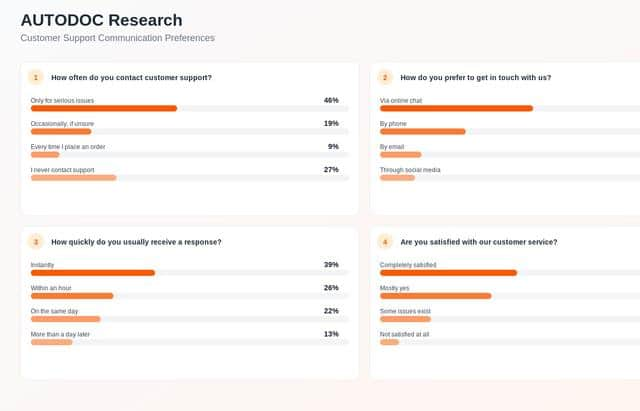
The research surveyed customers across four key areas:
Frequency of support contact:
● Only for serious issues: 46%
● Occasionally, if unsure: 19%
● Each time an order is placed: 9%
● Never contact support: 27%
Preferred communication channel:
● Via online chat: 48%
● By phone: 27%
● By email: 13%
● Through social media: 11%
Response time experience:
● Instantly: 39%
● Within an hour: 26%
● Same day: 22%
● More than a day later: 13%
Customer satisfaction levels:
● Completely satisfied: 43%
● Mostly yes: 35%
● Some issues exist: 16%
● Not satisfied at all: 6%
These figures demonstrate that nearly half of automotive customers have shifted to text-based communication, marking a significant departure from traditional phone-centric support models.

Several factors explain why text-based communication is becoming the preferred method for automotive inquiries:
⏰ Convenience and flexibility: customers can write messages anytime without interrupting their activities. Unlike phone calls that demand immediate attention, chats allow multitasking, which is a crucial advantage for busy car owners managing work, family, and vehicle maintenance.
💾 Preserved communication history: all correspondence remains accessible, enabling customers to return to order details, part numbers, and recommendations. For instance, when confirming specific brake pad models or reviewing technical specifications weeks later, the information stays readily available without requiring new inquiries.
🚫Elimination of hold music and menu navigation: chat provides direct access to information without listening to automated responses or navigating multi-level phone menus. This streamlined approach saves time and reduces frustration.
📸Information accuracy: text-based communication enables customers to share links, photographs of damaged parts, part numbers, and VIN codes. This visual documentation reduces miscommunication and ensures precise part identification, which is critical when ordering automotive components where exact specifications matter.
😌Emotional comfort: many customers experience telephone anxiety or prefer having time to formulate responses. Written communication removes this pressure, allowing thoughtful consideration before replying.
🔒Privacy considerations: certain inquiries feel more comfortable in written form, particularly when discussing budget constraints or admitting unfamiliarity with automotive terminology.
⚡Operator efficiency: support staff can handle multiple chat conversations simultaneously, potentially accelerating response times. While invisible to customers, this capability contributes to the faster service times reflected in AUTODOC's research.
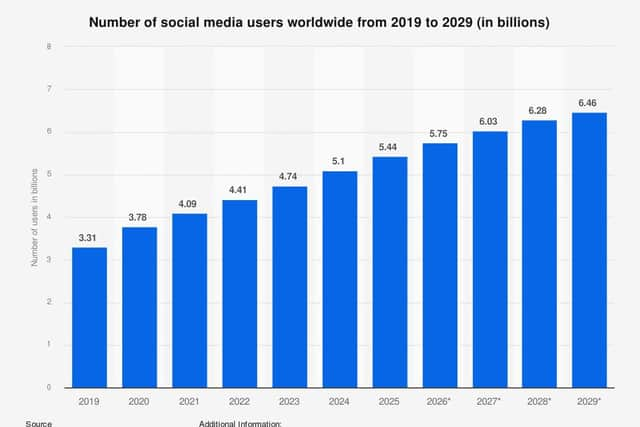
The preference for text-based communication extends far beyond the automotive sector. By 2025, the number of social media users worldwide exceeded 5.44 billion people, according to Statista. This figure represents a global shift in communication preferences, with projections showing continued growth toward 6.46 billion users by 2029.
This massive adoption of social platforms has fundamentally altered customer expectations across all industries. Users accustomed to instant messaging in personal communication naturally expect similar experiences when interacting with businesses, including automotive service providers and parts retailers.
The benefits of chat-based support become particularly evident in practical scenarios. An AUTODOC customer ordering multiple items, including air filters and cabin filters, utilised chat support to revisit the conversation several times for order clarification. This eliminated the need to restart conversations from scratch or explain the situation to different operators since all information remained readily accessible.
Such cases illustrate how preserved communication history transforms customer experience, particularly in the automotive parts industry where orders often involve multiple components with specific compatibility requirements. Customers can verify technical details, confirm part numbers, and review recommendations without relying on memory or handwritten notes.
According to AUTODOC representatives, the growth of online purchasing has changed the nature of customer support inquiries. The company reports that customers increasingly request fast, written communication forms.
AUTODOC states it is developing a multi-channel support system where online chat serves as one of the primary channels. According to the company, this approach allows for information delivery supported by links and images, which they note is relevant when selecting auto parts where specifications affect compatibility.
AUTODOC representatives indicate that while telephone communication remains available for users who prefer it, the company is investing in digital solutions that offer customers multiple interaction options. The research data shows 78% of respondents rated their experience as satisfactory (43% completely satisfied, 35% mostly satisfied), though 22% reported some level of dissatisfaction.
The transition from phone calls to chats represents more than a passing trend; it reflects evolving consumer needs that prioritise speed, convenience, and accuracy. Automotive industry companies like AUTODOC are actively adapting to these changes by investing in digital communication channel development.
The proliferation of AI and chatbot technologies will likely amplify this trend, making service interactions more efficient and personalised. As artificial intelligence capabilities expand, automated systems will handle increasingly complex inquiries while maintaining the written format customers prefer.
In the dynamic automotive parts and service sector, effective communication is a key driver of customer loyalty. Companies that successfully balance multiple communication channels while recognising text-based preferences are well-placed to build lasting customer relationships. The data clearly indicates that while phone support retains value for specific situations, the automotive customer of today – and tomorrow – increasingly expects the flexibility, precision, and convenience that chat-based communication delivers.