
Hastings retro with Steve Peak: St Leonards Pier's 135th birthday
See the latest news from Your World at https://www.sussexexpress.co.uk/your-world
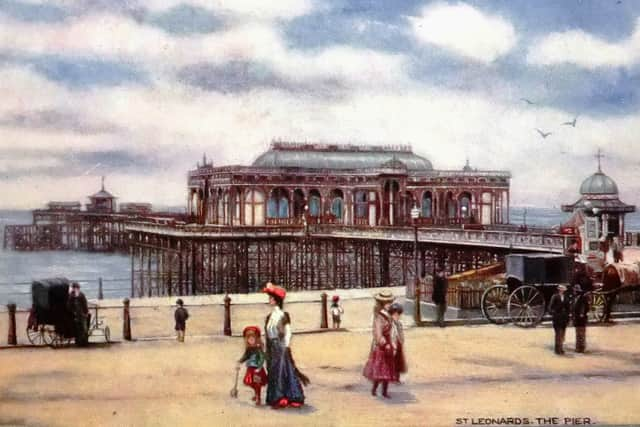
St Leonards Pier would be celebrating its 135th birthday on October 28th if it still existed – but unfortunately it doesn’t. It stood almost opposite the Royal Victoria Hotel for over five decades but was wrecked by a bomb in the Second World War and its last remains were cleared away in 1953.

The first proposal to build a pier in St Leonards came in mid-1872, just as Hastings Pier was about to open. The St Leonards idea never came to anything, but over the following years it became clear that the town of Hastings was benefiting from its pier, while neighbouring St Leonards was increasingly being seen by visitors as dull and uninteresting. However, St Leonards was growing rapidly in size, as it was a good place to live for elderly middle class people. Might they be persuaded to invest in a seafront attraction which could increase trade for local businesses and therefore help the overall economy of the town?
So in November 1884 a meeting was held in the Royal Victoria Hotel, where a group of local people agreed to acquire the legal permission necessary to build a pier. The main driving force behind the scheme was Richard Reed, the public-spirited owner of the hotel, who thought that there would be much local interest in such a pier and that it would be well supported.
But Reed actually found little backing from the more conservative well-off residents of St Leonards, many of whom saw piers as being an attraction only for the lower classes. The lack of financial aid was being felt before work could actually start on the pier, and so Reed held a public meeting in April 1887 which luckily managed to rally enough backing to enable him to go ahead with starting his dream.
Work began on the site 100 yards west of the hotel at 12.15pm on Thursday 1 March 1888 when the borough’s mayoress, Mrs Stubbs, began screwing the first iron pile through the sand and clay. That day was also the 60th anniversary of the laying of the first stone of the town of St Leonards itself. The Hastings Observer described the event as a “momentous occasion, which, it may fairly be said, marks an epoch in the hitherto uneventful history of St Leonards”.
The engineer and architect of the 960 feet long pier was local resident Richard St George Moore, who was also the engineer of the Brighton Palace Pier, built 1891-99. There would be a pavilion only 180 feet from the shore end, as Hastings Pier had found that having its pavilion at the far end of the pier had discouraged visitors in wet or stormy weather. Also, it would be especially convenient for the many residents of St Leonards who were invalids. There would be special gates and a form of driveway onto the pier so that better-off people arriving at the pier in horse-drawn carriages could be delivered to the pavilion’s door, whatever the weather.
The pavilion would be a 750-seat assembly room with club rooms on the south side. The rest of the pier was for promenading, with a landing stage for steamboats, a small bandstand and shelters at the sea-end.
It was built in a similar manner to Hastings Pier, with an iron structure of columns connected by girders. But Mr Reed found he had great trouble raising funds for the £30,000 project, because many St Leonards businessmen were supporters of Hastings Pier and did not like seeing a competitor.
The Hastings News reported that he told his company’s AGM in March 1889 that “directors had lacked the support they had expected ... due to the apathy of the owners of property in the neighbourhood. ... They [the directors] had not received a shilling of support from landowners who would be considerably benefitted by such an attraction, and which must be conducive to the welfare of the town”. The company had run out of money during the past year and had been forced to take up the offer of a £7,000 mortgage by the South Eastern Railway Company (SER), which was hoping that the new St Leonards Pier attraction would bring more train-using visitors to the town.
The construction continued in an intermittent form, hampered by the uncertain finance, by delays by the contractors and bad weather. A severe gale caused much damage to the seaward end of the pier on 4 October 1889. The company AGM in February 1890 heard again from Reed that they were still not receiving the amount of local support which they had expected, and “in several instances promises to take shares have not been fulfilled”, reported the Observer.
The erection of the substructure of the pier was finished on 9 October 1890, when Mrs Stubbs, still the mayoress, screwed in the last of the 22,500 bolts holding the framework together. But the ongoing financial problems delayed the finishing of the pier, and it was not formally opened to the public until 28 October 1891, three and a half years after the work had started.
There were many problems after opening, and the directors struggled as best they could, but eventually gave up, and on18 July 1892 the directors announced that the St Leonards-on-Sea Pier Company was being wound up. But the pier itself remained open and SER took possession of it, as they still held the £7,000 mortgage.
Luckily, SER then carried out major investment in the pier and it rapidly became as well-liked as Hastings Pier. Unfortunately, the man who had created the pier, Richard Reed, himself went bankrupt. He sold the hotel and moved to London, where he is believed to have spent the rest of his life in the Strand workhouse.
In March 1909 the SER gave a 20-year lease to the Rinkeries Company, an American corporation that owned several piers and roller skating enterprises in the USA. The pier was renamed as the American Palace Pier (usually just being called the Palace Pier), and big improvements were immediately carried out. Their aim was to turn it into an American ‘Fun City’ with all the latest and most approved attractions.
Over following weeks the pier was transformed, with the most striking improvement being a big new pavilion built as a roller skating rink at the seaward end of the pier. In September 1909 the Observer thought that “From a cold, bare, dreary, lifeless expanse of wood and iron the pier ... has become a veritable temple of pleasure and merriment”.
But business was not good, and in the spring of 1911 Rinkeries suddenly gave up its lease. Then in August 1917 the pier was bought by John Gardner, the well-off owner of several Welsh coal mines. His son had just been killed in action on the Western Front, and John for many years ran the pier in a public-spirited, non-profit way, raising much money to help injured troops and other people in need.
When John retired in 1933, aged 76, the pier was bought by two London speculators who added more attractions and renamed it the New Palace Pier. The summer of 1939 was the most successful season ever for the pier, but when war broke out on 3 September that year it was forced to close. It was taken over by the military early in 1940 (as was Hastings Pier), and to prevent foreign troops landing on it two gaps were cut, one in the middle and the other severing the pier from the promenade.
Then on 7 March 1944 a severe fire caused by a bomb destroyed much of the pier and it was abandoned. In 1951 Hastings Council bought the ruins and began removing everything still standing. By late 1953 all that was left of St Leonards Pier were some pieces of ironwork under the sand.
The only published history of St Leonards Pier is my book A Pier Without Peer, which tells the story of both of the town’s piers. Plus, on the seafront railings almost opposite the Royal Victoria Hotel, where the pier once stood, is a large display board with a potted history of the pier, which I put together with Hastings Council.