
Hastings retro with Steve Peak: The Hastings smuggler fighting slavery
See the latest news from Your World at https://www.sussexexpress.co.uk/your-world
King Charles’ nine-day visit to the Caribbean was overshadowed by calls for slavery reparations. But historian Lord Biggar has said that “The argument in favour of British reparations … refuses to take into account the fact that Britain was the first major power in the history of the world to abolish both slave-trading and slavery, permanently. It then led the world in suppressing the practices in Brazil, throughout Africa and in Australasia.”
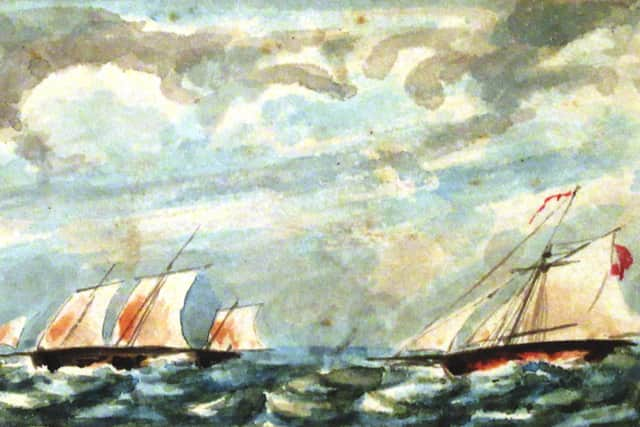

Playing an active part in abolishing slavery was a Hastings fisherman, although he had not actually chosen to do so. George Bumstead was caught in Rye Bay on 25 January 1825 trying to smuggle ashore 43 tubs of contraband spirits. George and his five mates were on the big three-masted Hastings lugger Dove, which was pursued and then boarded by Coastguards from an armed Revenue cutter. He was then sentenced to spend several years in the Royal Navy fighting the slavery trade on the west coast of Africa.
Amazingly, George, the convicted smuggler, actually kept an 88-page illustrated record of his many ventures, including the capture of 18 ships with a total cargo of 4,859 slaves onboard. Eleven of these vessels were Brazilian, four Spanish, two Dutch and one Portuguese; none were British. His coloured notebook is on permanent display at Hastings Museum and Art Gallery, alongside one of his biscuits!
On that day in January 1825 the six smugglers were taken to Dover, where on 3 February four of them, including George, were “condemned for sea service” and the other two imprisoned. The four, clad in “heavy irons”, were then put on board the 120-gun warship HMS Prince Regent in the River Medway. On 15 February they were transferred to the brig HMS Conflict which set sail for Africa a week later.
George served the next few years as a deck-hand in the West Africa Squadron, helping to suppress the Atlantic slave trade by patrolling 2,000 miles of coast around the British colony of Sierra Leone. Between 1818 and 1860 the Squadron seized more than 1,500 slave ships, and George himself was involved in, and recorded, many skirmishes. He spent much time on the three-masted man-of-war HMS Sybille, which freed 3,900 slaves from 1827-30. He noted in his diary the capture of the Brazilian ship Vangadore with 645 slaves on board.
The hand-written notebook is an almost day-by-day record of what he saw and did during his “condemned” years. He was particularly struck by the many African animals, plants and indigenous people he had never seen before. It is not known how long George spent off the coast of Africa, as the 88-page diary has lost its last pages, but he may have been on HMS Sybille when she returned to England in June 1830, and an 1836 census shows him again living in Hastings as a fisherman.
While in the Navy, George must have kept daily notes, which he wrote up as this diary on returning home. It has 11 watercolour illustrations, including one of the Dove being chased. It is on display, alongside the long-life ship’s biscuit and the packet it was kept in. The Museum is open Tuesday to Saturday 10am-5pm and Sundays 11am-4.30pm. Admission is free, and there is free parking in the grounds.
Ironically, the Museum is itself standing on land that was once part of a big estate belonging to a prominent local family who had owned 651 slaves two centuries ago.
The family was the Briscos, one of whom - Wastel Brisco Jnr - in 1832 bought the luxurious Bohemia House mansion, built about 1818, and its estate of about 90 acres on the east side of Bohemia Road.
The Briscos were one of the wealthiest families in the Hastings area. Some of Wastel Jnr’s money had come from a slave-run coffee plantation in southern Jamaica which he had part-owned with his brother, Musgrave Brisco Jnr when they were young men. In 1834-35 Musgrave Jnr had built the elegant Coghurst Hall on a big estate (now a giant ‘caravan park’) three miles north of Hastings, and he was a Hastings MP from 1844 to 1854. Their rich father, Wastel Brisco Snr owned Croft House, the largest house in Hastings Old Town.
A cousin of the two brothers was Sir Wastel Brisco who owned nearly 2,300 acres (seven per cent) of the island of St Kitts, one of the Leeward Islands in the Caribbean, where he had extensive sugar estates run by slaves. When the British government abolished slavery in 1833 the slave owners received compensation from the British state for the loss of their ‘property’ - ie, the slaves. Sir Wastel was given £10,609 (over £1.1 million in today’s money) for losing his 651 slaves. The slaves received nothing.
Wastel Jnr expanded the Bohemia estate, ending up with most of the land on the east side of Bohemia Road as far north as St Pauls Road, plus what are now White Rock Gardens and the Oval on the west side. This land remained undeveloped as Hastings spread north and west through the 19th century, being a ‘green lung’ for the surrounding housing estates.
In the early 1920s the widow of a wealthy doctor bought 2¾ acres of the Brisco estate and built on it a private house, which became Hastings Museum and Art Gallery in 1927 when she sold the building to Hastings Council.
Bohemia House became Summerfields School in 1903. It closed in 1966 when the last 47 acres of the Brisco estate were purchased by Hastings Council for £170,000. In 1968 the council began an ill-thought out and chaotic development programme of the estate on the east side of Bohemia Road, hoping to create a ‘civic centre complex’. First completed was the ambulance station, in 1969, followed by the fire station in 1971, the police headquarters in 1972, the law courts in 1975 and the long-delayed sports centre in 1980.
The attractive Summerfields House, behind the fire station, was demolished in early 1973, and some temporary planning offices were put there some years later. These have now been replaced by the Bohemy Fields housing estate, with a large block of 22 flats standing where once stood the Bohemia House mansion.
In Hastings there are no Brisco statues or other obvious reminders of this once-prominent slave-owning family, apart from Brisco’s Walk, running up the east side of the old estate, from Holmesdale Gardens to Horntye Road.
Find out more about the general history of Hastings and St Leonards on my website www.hastingshistory.net.