
Hastings retro with Steve Peak: The History of the Hastings Salvation Army
See the latest news from Your World at https://www.sussexexpress.co.uk/your-world
The 96-year old Salvation Army Citadel in St Andrew’s Square has reopened after being closed for 12 months for essential building works, including roof replacement, solar panels and new fire doors. The Citadel is now having coffee mornings on the third Saturday of every month, with the next on 21 November, from 10.00-12.00, with refreshments, games, books, handmade cards and crafts.

The large brick-built Citadel is standing on the site of a much smaller church erected in 1869 on what was then farmland. In the 1860s all the ground between what is now the Priory Meadow shopping centre and the Queens Road railway bridge was built on, including all of St Andrew’s Square. In October 1865 the plot of land forming the centre of the Square was sold for £350 to the Rev Dr Edward May. He then built on it the small Church of St Andrew, a modest building made of corrugated iron, which opened on 16 December 1869.
But a year later a much bigger and better church was built nearby in Queens Road. This was St Andrew’s Church, which was demolished in 1970 to make way for the Morrison’s petrol station. As the Queens Road church was the parish church it could be called St Andrew’s Church, which meant that the church in the square had to have a different name, so it became known as the Iron Church. After the parish church opened there seemed to be no reason for the continued existence of the Iron Church, and it became little used in the following years.
Nationally, the Salvation Army was founded in 1865 as the ‘East London Christian Mission’ by Methodist preacher William Booth and his wife Catherine. They sought to bring salvation to the poor, destitute and hungry by meeting both their ‘physical and spiritual’ needs. The Mission was set up after William made a sermon outside the Blind Beggar pub in Whitechapel Road. It was at this pub that the famous criminal Ronnie Kray shot and killed scrap metal dealer and fellow criminal George Cornell in 1966.
The Christian Mission attracted many supporters in Hastings, and on 17 December 1870 Catherine Booth held its first local meeting in the Market Hall in George Street, what was to be their headquarters until 1883. Through the 1870s they held meetings in the hall and the nearby fishmarket, and its members found themselves increasingly at loggerheads with the public because of their forceful campaigning.
The Mission’s name was changed in 1878 to the Salvation Army because it had become modelled on the military, with members wearing uniforms, and with its own flag (or colours) and its own hymns. William Booth became the ‘General’, and his other ministers were given appropriate ranks as ‘officers’, with the other members being ‘soldiers’. This militarism, with its forceful and noisy street marches and parades, seriously annoyed many people in the following years.
In May 1882 residents of St Andrew’s Square tried to buy the Iron Church from Dr May because it had become “unused and neglected, and has become in a dilapidated and ruinous condition, a disgrace and scandal to the neighbourhood.” They offered Dr May £1,200, but he refused, wanting £3,000.
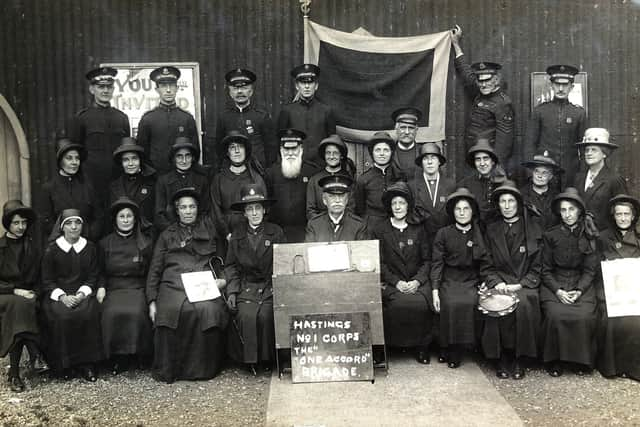
Then the Salvationists gave up their quarters in the Market Hall and rented the Iron Church from Dr May. They renovated it and moved in on Easter Saturday 25 March 1883, following a march from the Fishmarket to the church. The Hastings News reported that the 20-30 members in the procession were “accompanied by a large crowd, chiefly composed of the rougher element of the east end.” A service was then held in the church. “The congregation, made up chiefly of the lower classes, listened with a fair amount of attention.”
The Salvationists renamed the church as the ‘Iron Fort’, and it was to their base for their increasingly outspoken activities in following years. On 14 December 1883 three Salvation Army officers – Major Frank Smith, Captain William Beaty and Captain John Blandy – were convicted of disturbing the peace in a procession on Sunday 2 December from the beach near the Albion Hotel to the Fort. The magistrates also fined four men for taking part in an anti-Army serious disturbance on 3 December in St Andrews Square. “Stones were thrown, bad language used, shouting indulged in, and rough processionists perambulated the locality,” reported the Observer.
In mid-September 1884 a widely supported 'Skeleton Army' was set up in Hastings, staging rival processions aimed at stopping the Salvationists. This was part of a southern England Skeleton movement opposing the Salvationists which had started in 1881. On 27 September 1884 hundreds of Skeleton supporters marched round the town with banners, and then attacked the Iron Fort, throwing stones at it, making a sound like gunfire, and breaking windows. A shop in Wellington Place was stoned and large numbers of police had to break up the near-riot. The Fort had also become known as the ‘Salvation Army Barracks’.
In the spring of 1911 Hastings Council passed a new bye-law preventing political and religious meetings being held on the beach and seafront, especially at Denmark Place where many such events had been taking place. In early June, Adjutant Slee of the Army was arrested for being in charge of the local Salvationists during their recent protests over the new bye-law, and was locked up in Lewes Prison for three weeks. He was freed on 24 June and was given a great reception at Hastings, where more Salvationists were in breach of the bye-law. The bandmaster of the Salvation Army, Calber Jeffery, was summonsed for giving an address at the prohibited part of the beach at Denmark Place on 25 June. A fine of 30 shillings plus costs was imposed on 6 July, but he refused to pay.
On 13 October 1911 three more arrests of Salvation Army officers took place for speaking at Denmark Place. The three were released from jail on 29 November and a welcome home demonstration was held in the Iron Fort, conducted by Commissioner Higgins, the Chief Officer of the Salvation Army throughout the UK.
But the many positive activities of the Salvation Army during the First World War changed many people’s feelings about the Salvationists, bringing it much wider public support. By then it also had many branches overseas, including in the USA.
In the autumn of 1929 the Iron Fort was demolished, and the new brick-built Salvation Army Citadel was constructed on the cleared site. The opening ceremony took place on 24 May 1930 of what were originally two buildings: the Young Peoples Hall on the west side, and its larger principal worship hall on the east. These were designed as companion buildings with separate entrances, but today the two share a common entrance, and extensions have been built linking the north sides of both, effectively creating one large building.
During the Second World War the Young Peoples Hall was made available for the homeless.
In 1970 the Salvation Army marked 100 years of work in Hastings with a grand ceremony. Attendees included the ninth international leader of the Army, General Erik Wickberg. At that time, the Hastings Citadel was the sixth oldest Corps in existence and the first outside London to celebrate its centenary anniversary.
In Old London Road in Ore, next to the Speckled Wood entrance space, is the Hastings Temple of the Salvation Army. It occupies what was built as a cinema. Construction began in 1906 but was abandoned until 1913 when it was completed, and the Cynthia Cinema was opened in June 1913. It was owned by Mr R Bowden, but a new owner soon took over and it was renamed Clive Vale Cinema. Around 1921 another owner took possession and it was renamed the Princess Cinema. But it closed in May 1923 and was converted to retail use, with the Salvation Army taking it over in the early 1930s.
A representative of the Army said: “For more than 150 years, Salvationists in Hastings have combined Christian worship with practical care, friendship and service. The Citadel has witnessed profound changes in the town, yet its purpose endures: to share the Christian faith and offer welcome and practical support to the community.”