
Letter to the editor: Eastbourne further bans cycling
See the latest news from Your World at https://www.sussexexpress.co.uk/your-world
There is something deeply concerning about the way East Sussex County Council is approaching cycling in Eastbourne. This week, the council reconsidered their future approach to cycling along Terminus Road, between Bolton Road and Langney Road. They wrote “We have also considered the option of allowing cyclist access [and it ] will not form part of the Experimental Traffic Regulation Order”.

The council's own original consultation material makes clear that the Terminus Road ETRO would regulate cyclist access as well as vehicles and loading. The stated purpose was to find suitable timings for the pedestrianisation arrangements, including for cyclists. The latest Phase 2b consultation confirms that the restrictions are being trialled before a decision is made on whether they should become permanent.
This new decision to restrict cycling is not happening in isolation. It is part of a larger pattern, where at a Council planning committee in 2025, officers acknowledged that nothing they have done, has increased cycle numbers. So this is not merely a question of whether somebody likes cyclists in a pedestrianised street. It is a question of whether the council's transport policy is coherent.
ESCC says it wants more people to cycle. Its own and Eastbourne Borough Council’s strategies and policies talk of ‘modal shift’ where people make fewer journey by car and more walking and cycling. ESCC’s transport strategy recognises the importance of proper cycle infrastructure and refers to national guidance, including LTN 1/20, which covers everything from safety and junctions to crossings, and parking. Yet in the heart of Eastbourne, cyclists are once again being treated as a problem to be regulated rather than people whose journeys should be accommodated.
Cycling infrastructure has to be more than paint on a road or a line on a map. It needs to be safe, continuous and intuitive. It needs to take people where they actually want to go. It needs to work for children and older people who might cycle if they did not feel that doing so meant sharing hostile roads.
Eastbourne has enormous potential for cycling. It is relatively compact, largely flat and has a huge population living within cycling distance of the town centre. A pedestrianised town centre should be an opportunity to create a genuinely connected active-travel network, not another missing link. If cyclists are diverted, the alternative route on the A259 needs to be safe, practical and accessible. Otherwise, the policy risks becoming a self-fulfilling prophecy: make cycling inconvenient and unattractive, observe that few people cycle, and then use those low numbers as evidence that cycling infrastructure is unnecessary.
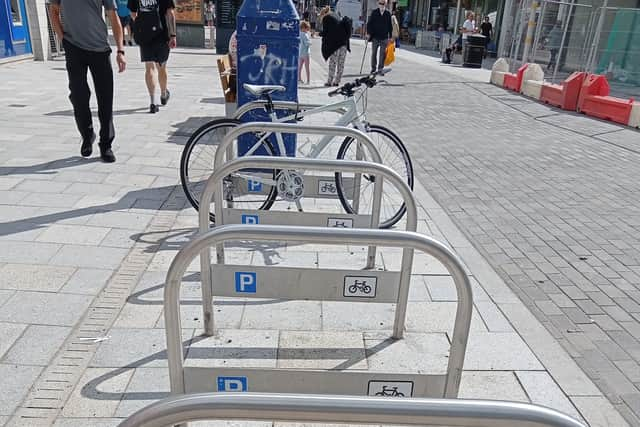
The council's current town-centre scheme advertises new cycle parking as one of its improvements. But cycle parking is not a substitute for cycle routes.
These views would most likely be supported by an external audit, using qualified professionals, who would come to the same conclusion as to the design of the new proposed cycle routes. Often just painted cycle ‘roundels’ on the road
Do not tell residents that cycling is a priority while simultaneously removing them from key parts of the town and offering an infrastructure network that even the authorities acknowledge has shortcomings.
Paul Humphreys Bespoke Cycle Group