
Sussex Heritage: Table's remarkable provenance unites us with the life of William Shakespeare
See the latest news from Your World at https://www.sussexexpress.co.uk/your-world
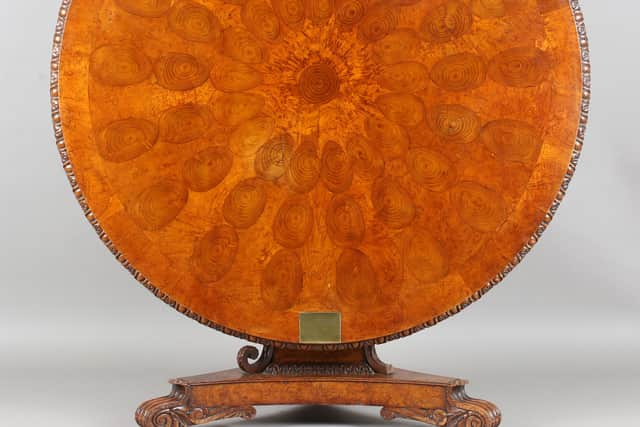
Toovey’s Head of Furniture, William Rowsell, has recently discovered and brought to sale an important Regency pollard oak and mulberry oyster-veneered circular tip-top centre table with great historical literary interest. The mulberry wood was purportedly from the mulberry tree that grew in William Shakespeare’s garden in Stratford-upon- Avon. The table has just sold for £10,000. William explains “The table top has 52 oyster veneered panels of mulberry wood which each represented a year of the Bard’s life.”
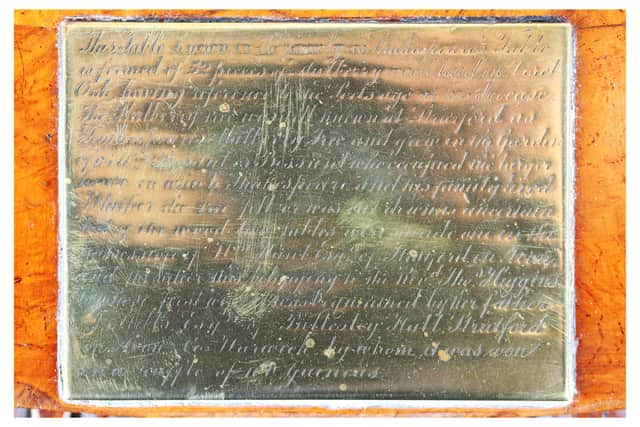

William shows me a brass plaque applied to the crossbanded border and says “The plaque is engraved with the table’s provenance.” He pauses, clearly excited and reads the inscription aloud “This table known in the family as 'Shakespeare's' table is formed of 52 pieces of Mulberry wood laid in local Oak having reference to the poet's age at his decease. The Mulberry tree was well known at Stratford as Shakespeare's Mulberry tree and grew in the gardens of a Mrs Besant or Bessant who occupied the larger house in which Shakespeare and his family lived. Whether the tree fell or was cut down is uncertain but of the wood two tables were made, one in the possession of Wm Hunt Esqr of Stratford and the other this belonging to the Revd Thos Higgins, to whose first wife it was bequeathed by her father, J. Mills Esqr of Billesley Hall, Stratford on Avon Co. Warwick by whom it was won in a raffle of 100 guineas.”
William explains “Shakespeare's mulberry tree must be one of the most famous trees in literary history. It’s thought to have been planted at his final home, New Place in Stratford-upon-Avon, around 1609. King James was encouraging the planting of mulberry trees across Britain to help build a domestic silk industry. The tree is believed to have been cut down in 1756, when the then owner of New Place, the Reverend Francis Gastrell, grew tired of tourists constantly visiting and asking to see the tree. Local carpenter Thomas Sharp bought much of the felled tree and many carved mementoes were made. After Sharp's death the remaining stock was purchased by John Marshall, who continued making similar objects. Whole logs were also made available to selected cabinet makers. The other table mentioned on the brass plaque is almost certainly now in the collection of The Shakespeare Birthplace Trust, along with provenance confirming that it was made for the Hunt family. This table’s provenance goes back to the Reverend Thomas Higgins and then by descent to the seller connecting us tangibly to William Shakespeare.”
Rupert Toovey is a senior director of Toovey’s, the leading fine art auction house in West Sussex, based on the A24 at Washington - www.tooveys.com - and a priest in the Church of England Diocese of Chichester.