
Uncovering the 1,000-year secrets of Cliffe's unassuming church
See the latest news from Your World at https://www.sussexexpress.co.uk/your-world
Most visitors to Lewes in East Sussex will think of it as a small town stretching from the white cliff at one end right up to the Victorian prison at the other, with the Norman castle proudly sitting in the midst. However, today's town actually consists of several quite different ancient settlements, and none is more ancient than that part of the town known simply as “the Cliffe” with its modest but historic church of Saint Thomas à Becket. One pointer to this lost past is that the town is actually divided by the river Ouse, which at the time Saint Thomas was constructed would have been larger and deeper, presenting a significant obstacle.

Nonetheless, it is thought that crossings between the Cliffe and Lewes would have existed since Roman times or even earlier—not as a bridge but more likely as a ford or ferry. The exact date of the first bridge is unknown, but what is recorded is that in 1159 a bridge connecting the Cliffe to Lewes proper was being repaired. Four hundred years later, in 1561, records talk of the bridge being rebuilt, and two hundred years after that—of it being swept away! It was only in 1726–1727 that the foundations of the bridge we know today were finally laid—a stone-arch bridge built by Nicholas Dubois.
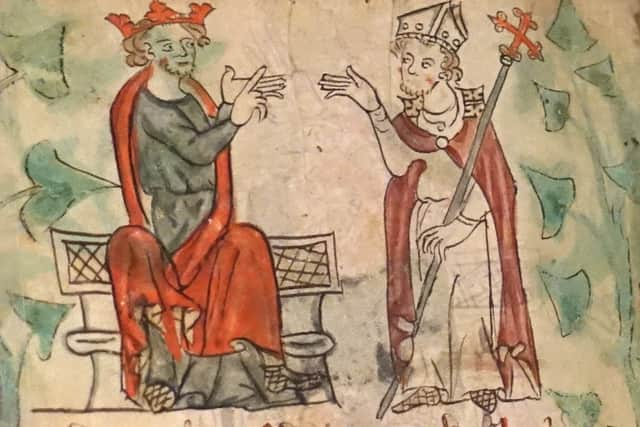
Bridges are understood to face regular battles with their rivers, but similar challenges seem to have been faced by the Cliffe’s church too, and over the same timescale. The 1,000-year history of the Saint Thomas à Becket Church in Cliffe, Lewes, spans the late Saxon/Norman period through medieval reconstruction to the modern day. The Domesday Book describes a settlement in 1086 linked to Canterbury, while it is in the late 12th century that a chapel dedicated to Thomas à Becket appears.
This church was reconstructed in the 14th century with octagonal (eight-sided) stone pillars, a 'squint' (a peephole used to view the altar), and a stone wall-sink known as a piscina.
During the following two hundred or so years, Saint Thomas gained other remarkable features, including the oldest royal arms in Sussex (Queen Elizabeth I, dated 1598), a 1670 turret clock, George I and George II oil paintings, and 18th-century gallery and porch conversions.
Finally, in the Victorian period, the church underwent major restorations, including gallery removals, flint refacing, and the addition of stained glass windows.
All of which is to say that this very unassuming church tucked away at the eastern end of Lewes is actually a remarkable historical gem. And that's why, on Friday 20 November, Peter Varlow will give the second lecture of the 2026–27 season to the Lewes Archaeological Group on ‘The History and Archaeology of St. Thomas à Becket Church, the Cliffe, Lewes’. The talk is in the Lecture Room of Lewes Town Hall, at 7:30pm. Non-members are very welcome, £4 cash on the door, with free entry for those aged 25 and under.