
Buzz of hope as Sussex leads the way in pollinators campaign – but charity calls on everyone to help fill the gaps

With the countryside's beauty and health under serious threat, Sussex is leading the way in a campaign to connect pollinator-friendly habitats across the nation.
Conservation charity Buglife is calling on everyone from balcony gardeners to landowners to join in by managing green spaces for pollinators, celebrating these pollinator-friendly spaces and adding their habitat, large or small, to the B-Lines map.
Every piece of land can help, from balcony herb garden to sprawling meadows, to fight the growing threats to wildlife from habitat loss, fragmentation, climate change and chemicals.
Rachel Richards, Buglife B-Lines officer, said: "Our countryside's beauty and health for both wildlife and people is under serious threat. But every single person can make a difference. Whether you're growing herbs on a balcony, managing a park or nature reserve, or stewarding species-rich meadows, your contribution matters.


"Today, we are asking everyone who can, to help create pollinator friendly habitats and then add it to the B-Lines map on our website, no matter how big or small. We would like to be inspired by what you’re doing and for what you’re doing to further inspire others."
The Changing Chalk partnership project on the South Downs has been leading the way by showing what can be done for pollinators, with its focus on protecting and enhancing chalk grasslands from Shoreham to Eastbourne.
Led by the National Trust, Changing Chalk is a landscape-scale partnership connecting nature, people and heritage. The ten core partners, including Buglife, have been supported by a £2.23million National Lottery Heritage Fund grant.
The work since 2022 has improved 467 hectares of priority chalk grassland for pollinators. This includes scrub removal, creating 50 hectares of chalk grass habitat to connect other sites, restoring six dew ponds and creating three urban bee banks – in particular through work with local farmers and Sussex Wildlife Trust.
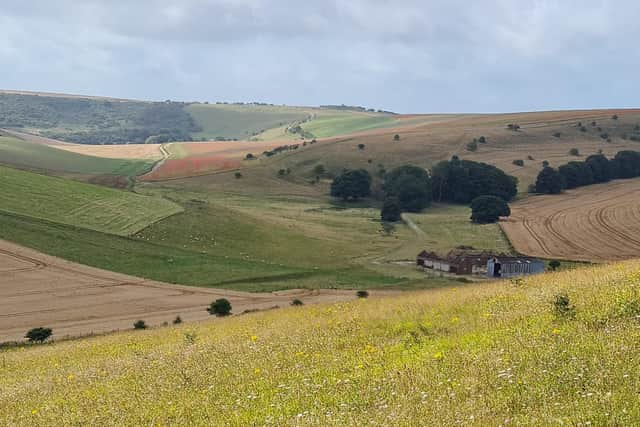
Alice Parfitt, Buglife Changing Chalk conservation officer, said: "In chalk grassland habitats, management is needed to ensure an open mosaic is maintained. Of course, scrub is an important habitat, too, and the flowers of species like hawthorn, blackthorn and gorse provide pollen and nectar for pollinators; however, without management, scrub is likely to take over and we may loose these precious flower-rich grasslands.”
Flower-rich habitats are increasingly vital, as pollinators face mounting pressures from multiple sources. By mapping and connecting these spaces, B-Lines aims to inspire others and identify where additional pollinator-friendly habitats are most needed.
There are still a lot of gaps on the B-Lines map around the South Downs and Changing Chalk project area but anyone can do their bit for pollinators and then add their work to the map. The Changing Chalk team and volunteers are giving advice to farmers and landowners on how to improve their land for pollinating insects, while carrying out habitat and species surveys.
Alice said: "Changing Chalk works with a number of dedicated partners who are doing fantastic work. The Living Coast Unesco Biosphere have created a new solitary bee nesting bank, Brighton and Hove Council are restoring a golf course to chalk grassland and other habitats for wildlife, and the National Trust have created wildflower-rich grassland at their site at Gayles Farm to provide resources for pollinating insects and to provide linkages through the landscape. But helping pollinators and our wildlife can encompass small actions, too.”

Changing Chalk is focusing on the chalk grassland landscape of the South Downs, Sussex and the communities of the coastal fringe between Brighton and Hove, Eastbourne and Lewes. Buglife is leading on three projects within the partnership, to address the challenges in protecting and enhancing this fragile chalk grassland for future generations.
Stuart McLeod, regional director for The National Lottery Heritage Fund, said: “Changing Chalk is a fantastic example of partners coming together to improve our natural heritage. Pollinators are a vital part of our ecosystems and this project with Buglife will encourage people to plant for nature, connecting habitats and creating wildlife corridors. It’s inspiring to see people across Sussex – whether through small patches of wildflowers or by managing larger landscapes – taking action to help species thrive and support nature’s recovery.”
Restoring insect pathways and creating wildflower-rich stepping stones across the nation can help bees, butterflies, beetles and other wildlife to move across the landscape.
Home gardeners can help by growing pollinator-friendly plants, community food growers can work without herbicides and pesticides, farmers can steward species-rich hay meadows, restore species-rich hedgerows or create new flower-rich habitats, local authorities can improve public green space management, and volunteers and conservation groups can manage nature reserves.
All pollinator-friendly work can be added to the B-Lines map. Visit buglife.org.uk/our-work/b-lines and scroll down to the map, then hit the green 'Add Site' button in the top right hand corner to add your green space.