
London Gatwick Northern Runway plans: Campaign group questions how airport will benefit from doubling freight with only one smart road

A campaign group has questioned how London Gatwick airport will benefit from doubling their freight if their proposed plans for a new runway get the go ahead, when there is ‘only one smart 'deemed dangerous' road’.
A new report says London Gatwick could provide a significant boost for growth and resilience of freight across the South East, and support unlocking long-term growth, if the airport’s Northern Runway plans are approved this month.
The decision on the proposed plans is expected on February 27.
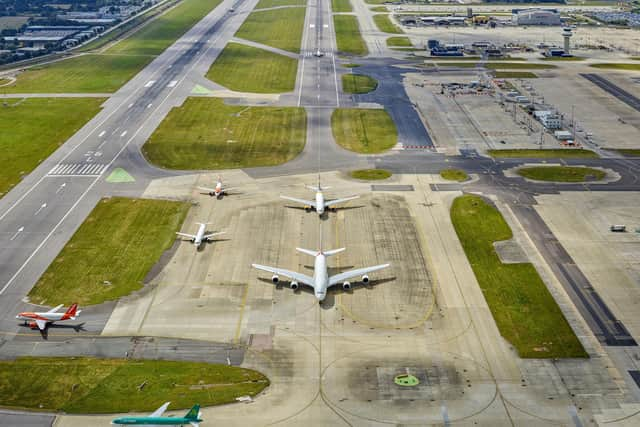
The airport is in the final stages of waiting for government approval to bring its existing standby Northern Runway into regular use. If approved, the plans could bring an additional 60,000 flights per year and see an increase to 161,500 tonnes of cargo by 2038 – more than double 2019 levels. The majority of imported cargo through London Gatwick currently arrives in the belly of aircraft from long-haul destinations in Asia and the Middle East – key trade markets which would be further supported by increasing flights to and from the airport.

An increase in the volume of imports will also see a rise in trade-facilitated employment across the UK. With the Northern Runway project, employment would increase to 167,500 jobs in 2038, 35,500 more than without the development.
But CAGNE (Communities Against Gatwick Noise Emissions) strongly oppose the proposed plans and have promised to launch a legal battle if they get given the green light.
And on the potential doubling of imports, a CAGNE spokesperson said: “Here we go again with Gatwick trying to compete with Heathrow on freight, as they did with the 2014 Airport Commission’s research into a new runway in the south east.
"What communities should be asking is, how will the freight get to and from the airport without an expanding railway line (that is already meant to accommodate 32m additional flyers)?
“The biggest concern for Gatwick should be the lack of reliable onward surface access available to freight handlers.
“There can be no freight availability on the railway, the single line already being almost at capacity with passenger trains, and proposed by Gatwick to accommodate 32m extra flyers.”
Detailed modelling of London Gatwick’s plans – which were drawn up in consultation with National Highways – show proposed improvements to local roads would provide sufficient extra capacity and improve traffic flow.
These plans include separating local and airport traffic with two flyovers at the airport’s South Terminal and North Terminal roundabouts, a new lane westbound over the Brighton main rail line, and a third lane to the A23 approaching Longbridge roundabout.
The CAGNE spokesperson added: “The M23 is deemed a dangerous smart motorway – designed for natural growth in the Southeast, not for Gatwick expanding with two or three runways.
“Gatwick specifies that cargo would increase to over 200,000 tonnes with a second runway. That would require the equivalent of over 7,600 three-axle arctic lorries - using government lorry carriage figures.
“If we take the next figure of 320,000 tonnes of cargo by 2038, that could be nearly 12,800 three-axle rigid lorries on the roads.
“So, who will pay for a new runway to please Gatwick’s shareholders’ ambitions of making Gatwick as large as Heathrow is today, with no sustainable transport plan to take traffic away from the roads?"
The £2.2 billion Northern Runway is 100 per cent privately financed.