
REVIEW: Why this homage to our comedy greats has the last laugh - in every sense - at Chichester Festival Theatre

The first production of the Winter 2026 season at Chichester Festival Theatre is The Last Laugh, an affectionate tribute to some of the greatest comedians of the late 20th century – Eric Morecambe, Tommy Cooper, and Bob Monkhouse.
When Steve Royle utters the iconic line ‘I'm playing all the right notes, but not necessarily in the right order’ the audience roars.
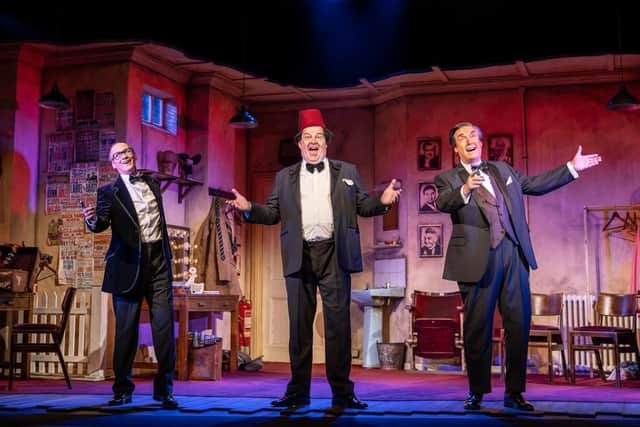

In that instant, Royle’s transformation into Eric is complete and we are transported back to our television screens on Christmas Day in 1971 for the Morecambe and Wise Christmas Show – an annual institution which dictated dinner time for at least half the nation.
The line is as indelibly linked to Morecambe as the Four Candles sketch is to the Two Ronnies.
It was delivered following Eric’s attempts to play Edvard Grieg's Piano Concerto in A minor in front of celebrity guest and conductor André Previn – who has just told him: ‘You're playing all the wrong notes.’
When the audience cries with laughter this time round in the CFT it’s not because of the enduring humour of the moment.
It’s due to the sharp prick of memory which reminds everyone of a certain age just how much they loved M&W. What a special time those shows were in their lives. Why the world of comedy – now often political, brutal and unsophisticated – has all too often abandoned its innocence of fifty years’ ago when a double entendre was as risky as it got.
Of course Morecambe, Tommy Cooper (Damian Williams) and Bob Monkhouse (Simon Cartwright) all died too young. The first two just off stage and just on and almost certainly from the stress of constantly seeking the reassurance of the public.
So The Last Laugh is appropriately set in a tatty dressing room in an imaginary regional theatre which could have been the showground of any of them.
Tommy Cooper, wearing little more than an old vest, socks, and Y-fronts, is getting ready to dress and go on stage when the lights flicker and in walk Eric and Bob. There then ensues a joyful reimagining of their conversation.
It is a script and a performance rooted in the most profound research. We know this, because the second half of the evening features a question and answer session with the three actors and – on Tuesday evening – with author Paul Hendy. All four are aficionados of their comedy heroes, constantly seeking out nuances to improve their performances.
And these are acts of great skill and not merely impersonations, as they are quick to confirm. Rather than caricature, with broad brush strokes they reveal something of the soul of their three celebrity heroes.
Hendy confirms that he chose these three for his ‘love letter to the golden age of comedy’ not just because the public adored them – but as much to highlight their contrasting styles.
Cooper was naturally funny. He couldn’t help it. We’re told even when he was crying in the street people gathered round on one occasion and started laughing. Monkhouse – as much renowned for hosting a string of popular TV quiz shows – was meticulous in his written preparation. Every comic line was chiselled and polished before being committed to one of his legendary books.
Eric with comedic partner Ernie Wise combined a natural flair for happiness with an intense rehearsal routine. Nothing was left to chance. Except, we were told with irony, their most famous sketch with Previn when time had been against them.
A string of global stars were paraded on their shows and the humour sprang as much from the lines and farce as the manner in which they treated them with commonplace disdain.
So the gags – often built on clever verbal constructs and at other times as basic as walking through a white gate – defined an age and united the British public in a way that nothing else could.
Back then, television comprised just three main terrestrial channels, and without streaming or home recording devices, everyone watched at the same time and in their tens of millions. The next day, in shops and offices and pubs it was the main source of conversation and everyone was an armchair critic. Both through the ability of TV to archive their material as well as its audience reach, it brought them an immortality unheard of just a generation before.
Hauntingly, the show’s title ‘The Last Laugh’ reflects their early demise as well as emphasising their enduring power. But as the show winds to its touring conclusion in Chichester there is also an unintended nod to that too.
Whatever your age, this is a clever and utterly engaging reconnection with our comedy greats who, as the song goes, brought us sunshine. It exudes love, kindness, gentleness, and helps us all to understand the addiction that afflicted each of them. The constant need to extract an ever bigger laugh from those they served.
For a play that brings down the curtain on their lives it could not be a better curtain raiser for the winter season at the CFT.