
Arts Society Horsham learns about Gaudi and other Catalan architects
See the latest news from Your World at https://www.sussexexpress.co.uk/your-world
From Horsham to Barcelona? That was an invitation hard to resist especially when it turned out to be a guided tour of the fascinating architecture by its most famous son Antoni Gaudí!

Led by our Spanish art expert Dr Jacqueline Cockburn, we learnt about how Gaudí engaged with nature in the most innovative and extraordinary ways such as taking inspirations from honeycombs and spiders' webs, armadillo skins and mushrooms, trees and whales' bellies! We followed a meticulous study of the ravishing buildings and gained a deep insight into Gaudí’s architectural designs and the key pillars of influence on his work.
Gaudí was born into a family of coppersmiths and developed an early intuition for space and an admiration of Nature from his childhood. By the time he entered architecture training, Barcelona was becoming a city of commerce and industry and the city’s rapid expansion attracted artisans, designers, builders and architects taking on commissions for the new Catalan bourgeoise and from municipal projects.
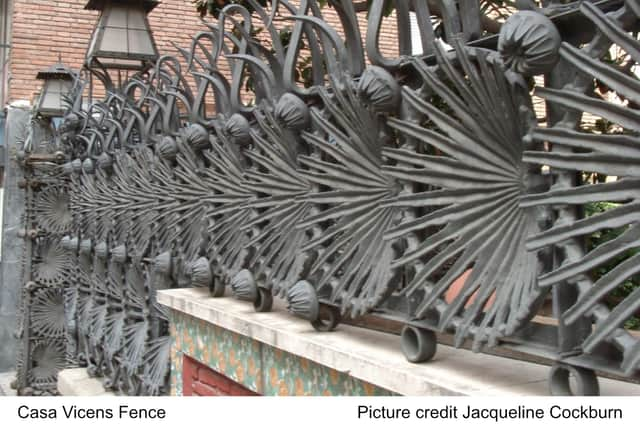
One of Gaudí’s first commission was two lamp posts located on Plaza Real. Already his penchant for natural motifs and mythical creatures was much in evidence! Gaudí’s first private project was Casa Vicens, conceived in Neo Mudejar (domesticated) style, characterised by colourful tiling, decorative wrought iron railings, stained glass windows and curved tiled ceilings! His chance meeting with artist Eusebi Güell became an enduring relationship which resulted in many landmark buildings, now recognised as World Heritage by UNESCO. These include Finca Güell, Palau Güell, Park Güell and Colonia Güell.
Other major commissions include the modernist Casa Milà also known as La Pedrera (meaning “stone quarry” in Catalan), the Baroque Casa Calvet and Casa Batlló with numerous intricate tiling and broken pots forming a dragon’s back as the roof line! The recurring themes of his fantastical and playful creations bear witness to Gaudí’s love for nature and the influence of Spain’s Islamic history and culture, Romanesque and Gothic style as well as heralding modernism in the form of Art Nouveau.
The most enduring project is of course Sagrada Família which started in 1882 and despite Gaudí spending the last 14 years of his life dedicated to its construction, it remains unfinished to this day. It was poignant to note that the quiet, unassuming man who flourished flamboyantly in his designs should live the last years of his life as a hermit and devoted himself only to God. But then in appreciating Gaudí’s work, it was always about lifting our eyes to heaven in celebration of nature and God the Creator.
While we were also introduced to the other Catalan architects - Domenech y Muntaner and Puig y Cadafalch who carry their distinctive styles such as the use of heraldic shields and references of St George, they appear as companions to the bright star of Antoni Gaudí in “Constellation Catalan” in the making of modern Barcelona!
Rowena Kerr
Lectures Secretary